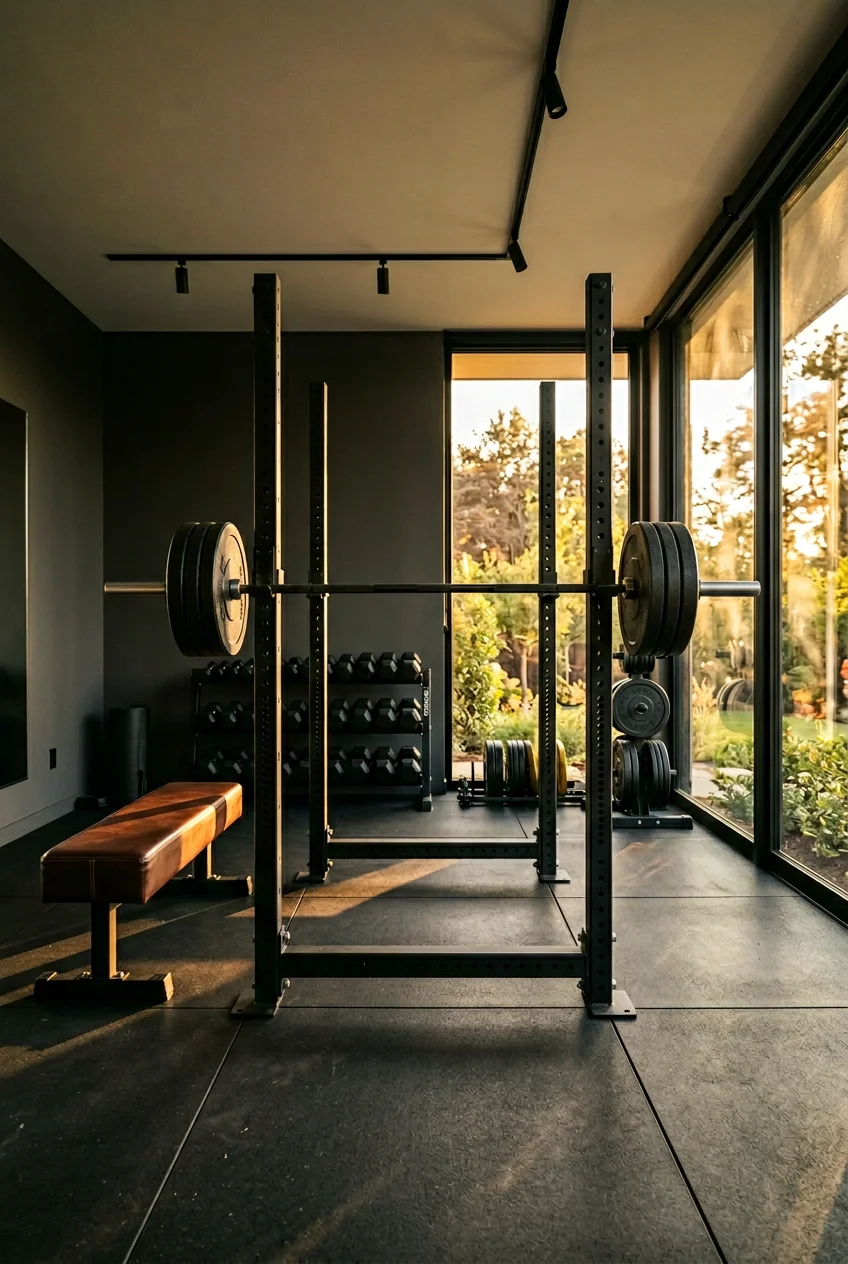
Three years ago, I stood in my freezing garage staring at a $1,200 rusty power rack that didn’t fit under my ceiling. If you want practical home gym setup ideas that actually work, you’ve got to avoid the massive, expensive metal mistakes I made. I’m Ryan, and I’ve spent the last decade building workout spaces in everything from tiny studio apartments to massive two-car garages. Last Tuesday at Whole Foods, a guy in the produce aisle noticed my gym-branded hoodie and asked me how to get fit without leaving his house. He was tired of paying $150 a month for a crowded commercial gym where he had to wait twenty minutes just to use a bench. I told him what I’m about to tell you. Forget the fancy marketing and the perfectly staged Instagram photos. You need gear that fits your actual life, flooring that doesn’t smell like toxic waste, and a realistic plan. Building a home gym isn’t just about buying heavy metal objects. It’s about creating an environment that forces you to be consistent. Skip the fat-free stuff, metaphorically speaking. It tastes like wet cardboard. Get the heavy, solid, real equipment that actually works. Let’s build a space that gets you actual results in 30 days.
1. Top Home Gym Setup Ideas: Measure Your Space Meticulously

Most people get this wrong right out of the gate. They buy a massive rack, drag it home from Target, and realize they can’t even slide the weights onto the bar. I tried this wrong for months before figuring it out. I had my bench shoved against a wall, scraping my elbows on the drywall every single time I pressed. For a compact weightlifting setup with a power rack, barbell, plates, and bench, you need at least 8 feet wide by 7 feet long (244cm x 215cm). Honestly, 9 feet wide is way better so you aren’t smashing your fingers when loading 45-pound plates. A typical 10 by 10 foot room works perfectly. Ceiling height is the real killer. You need at least 7 feet of clearance for chin-ups and overhead presses. If you’re tall, add another 8 to 10 inches for the plate diameter on your barbell. Grab a simple $4.99 Stanley tape measure from Walmart and check every single dimension twice. Don’t guess. Guessing leads to buying a $600 squat rack that becomes an expensive coat hanger. Measure the door frames too. You can’t fit a pre-assembled bench through a standard 28-inch closet door. Took me years to figure out that one.
2. Invest in Space-Saving Adjustable Dumbbells

You don’t need a massive commercial dumbbell rack taking up half your floor. I used to own ten pairs of hex dumbbells rolling around my basement, stubbing my toes in the dark. It was a nightmare. Ditch the clutter and get adjustable weights. I personally swear by the Bowflex SelectTech 552 Dumbbells. They cost around $429 to $549 depending on if you catch a sale at Costco or Dick’s Sporting Goods. They range from 5 to 52.5 pounds with a quick dial turn. The dial mechanism clicks into place with a satisfying, heavy sound. It makes supersets incredibly fast. You drop the weights in the cradle, turn the dial, and pull out a lighter weight in three seconds. Skip the cheap knockoffs on Amazon. I bought a weird off-brand pair once for $150, and the plates literally rattled and fell off mid-bicep curl. It almost crushed my foot. Stick to the name brands for anything holding heavy iron over your body. These Bowflex ones replace 15 sets of weights, leaving you plenty of room for other gear.
3. Prioritize Thick Rubber Flooring (Don’t Skip This)

Concrete and cheap tiles will destroy your joints and your equipment. If you drop a 50-pound dumbbell on bare concrete, it sounds like a gunshot and leaves a permanent crater. I know because my old garage floor looks like the surface of the moon. Do not buy those thin, colorful puzzle mats for a heavy lifting space. They squish under your feet during heavy squats, throwing off your balance. You need dense, heavy rubber. The absolute best hack is buying Tractor Supply Horse Stall Mats. They cost about $2.38 per square foot. They’re 3/4-inch thick, weigh about 100 pounds each, and smell heavily of raw rubber for the first week. You’ll need to leave your windows open. If you want something that doesn’t smell like a farm supply store, you can upgrade to Rogue Regupol or PLAE Forge rolled rubber. Those run about $5 per square foot for 1/2-inch thickness. You can find decent EVA foam tiles at Sprouts for $1 to $3 per square foot, but only use those for light yoga or stretching. For heavy iron, get the horse stall mats. They absorb noise, protect your floor, and give your shoes actual grip.

Adjustable Dumbbell Set
Honestly, Adjustable Dumbbell Set surprised me — sturdier than it looks in the photos, and over 79 buyers gave it 4.5 stars.
4. Utilize Vertical Space With Wall-Mounted Racks

Floor space is your most valuable asset. If you leave your jump ropes, resistance bands, and lifting belts in a pile on the floor, you’re going to trip and break an ankle. I used to throw all my gear into a plastic bin from Kroger, and it drove me crazy digging through it every morning. You need to use your walls. Install a folding rack if you want to park your car in the garage. The PRx Profile PRO Squat Rack is incredible. It costs around $899, and it folds up to just 4 inches off the wall. You literally pull two pins and the whole thing swings away. The heavy steel clanks into place, feeling rock solid. For the smaller stuff, I highly recommend Wall Control metal pegboards. A standard 16 by 32 inch panel costs about $22.99 on Amazon. I’ve got three of them bolted to my studs. They hold my 2-inch thick resistance bands, my 4-ounce chalk bag, and my leather lifting belt. Keeping things off the floor makes your gym look bigger, cleaner, and way more professional. Don’t leave your gear laying around. You might also like: 15 Creative Workout Motivation Tips You Haven’t Thought Of
5. Build Your Gym in Phases to Save Cash

You don’t need to drop five grand on day one. That’s a massive rookie mistake. People get hyped up, max out their credit cards on a full setup, and then use it twice. Adopt a phased approach. Start with the absolute bare minimum. Get a thick yoga mat, some adjustable dumbbells, and a set of heavy resistance bands. You can get all of that for under $500. Work out with just those items for 30 days. If you actually stick to the routine, then reward yourself by buying a flat bench. Wait another month, then buy the squat rack and barbell. A comprehensive gym can run you anywhere from $1500 to $3000, so spreading it out saves your bank account. Last month, I was walking through Walmart and saw people loading up shopping carts with cheap plastic weight sets. Don’t do that. Buy high-quality pieces slowly. Hunt for deals on Facebook Marketplace or Craigslist. You can often find people selling perfectly good cast iron plates for a dollar a pound because they’re moving. Just bring a truck and some heavy-duty work gloves, because those old plates are usually covered in dust and spider webs. You might also like: 15 Cozy Aesthetic Morning Workout Routine That Are Totally Worth It
6. Define Your Goals Before Buying the Big Stuff

Buying equipment without a clear fitness goal is like going to the grocery store starving. You end up with a bunch of junk you don’t need. If your goal is heavy powerlifting, a flimsy multi-gym with a 150-pound weight stack is completely useless. You need a real power rack. The REP PR-4000 Power Rack is an absolute beast. It starts around $800, features 3×3 inch 11-gauge steel, and will literally outlast your house. The powder coating feels gritty and secure in your hands. But if cardio and weight loss are your main focus, that rack is a waste of money. I’d skip that and buy a NordicTrack Commercial 1750 Treadmill, which runs about $1,999. I had a client last year who bought a $2,000 rowing machine because she saw it on Instagram, but she hated cardio. It sat in her living room gathering dust until she sold it for half price. Figure out exactly what you want to achieve in the next 30 days. Write it down. Only buy the gear that directly supports that specific goal. Stop buying stuff just because it looks cool online. You might also like: 15 Creative Inside She Sheds Home Gym Setup Ideas to Steal Right Now

WHATAFIT Resistance Bands
A dependable everyday pick — WHATAFIT Resistance Bands pulls in 356 ratings at 4.5 stars. Not flashy, just solid.
7. Essential Home Gym Setup Ideas Include Full-Height Mirrors

You might think mirrors are just for taking selfies, but they’re a critical safety tool. When you’re squatting 225 pounds alone in your basement, you need to see if your knees are caving in. You can’t rely on feeling it until it’s too late. One of the best home gym setup ideas I can give you is to mount full-height mirrors on at least one wall. I bought three frameless 36 by 60 inch mirrors from Home Depot for about $55 each. I glued them directly to the drywall using special mirror mastic. It took me three hours on a Sunday afternoon, and my hands were covered in sticky black glue, but it completely changed my workouts. Mirrors reflect the light, making a dark, cramped 10 by 10 foot room feel twice as big. They force you to be honest about your depth on squats and your back angle on deadlifts. Just make sure you mount them a few inches off the floor so a rolling dumbbell doesn’t shatter the glass. I learned that the hard way when a 10-pound plate cracked my center mirror right down the middle.
8. Add Smart Home Gym Tech for Guided Workouts

Connected fitness is taking over, and honestly, it’s pretty incredible. If you hate planning your own routines, smart gyms are the way to go. The Tonal 2 Smart Home Gym mounts directly to your wall and offers up to 250 pounds of digital resistance. It costs around $3,995 plus a monthly subscription, but it replaces an entire room of equipment. The digital weight feels wildly different than traditional iron. It pulls back against you constantly, making the eccentric part of the lift brutally hard. If you don’t want to drill into your studs, look at the Speediance Gym Monster 2. It sits on the floor, offers up to 220 pounds of resistance, and folds up like a suitcase. It runs about $2,699. These machines track every single rep, adjust the weight automatically if you’re struggling, and give you real-time form feedback. I tried a buddy’s Tonal last month, and the AI told me my left arm was pulling 15% weaker than my right. I had no idea. It’s like having a personal trainer standing right next to you, minus the awkward small talk.
9. Set Up Proper Lighting and Airflow

A dark, stuffy room will absolutely kill your motivation. Nobody wants to work out in a space that feels like a medieval dungeon. I used to lift in a windowless basement with one flickering yellow light bulb. It was depressing, and I skipped half my workouts. You need bright, energizing light. If you don’t have natural sunlight, buy some heavy-duty LED shop lights. You can get a 4-pack of 4-foot LED strips at Costco for about $39.99. They snap right into the ceiling and flood the room with crisp, white light. Airflow is just as critical. When you’re sweating through a heavy circuit, the air gets thick and gross in about ten minutes. Buy a high-velocity floor fan. I use a 20-inch Lasko industrial fan that costs $54 at Target. It sounds like a jet engine when you turn it on, but it moves a massive amount of air. Position it in the corner pointing slightly upward to circulate the oxygen. Trust me on this, breathing fresh, cool air makes a heavy set of walking lunges significantly less miserable. Don’t rely on a tiny desk fan.

Resistance Bands for Working Out
A dependable everyday pick — Resistance Bands for Working Out pulls in 278 ratings at 4.5 stars. Not flashy, just solid.
10. Buy Safety-Critical Equipment Brand New

I love saving money on used gear, but you’ve got to draw a hard line when it comes to safety. Go ahead and buy rusty cast iron plates or a scratched-up curl bar off Craigslist. But never, ever buy a used power rack or an adjustable bench from a stranger. You really don’t know how much abuse that metal has taken. If a weld snaps while you have 300 pounds on your back, you’re going to the hospital. Always buy safety-critical equipment new. A brand new Force USA C10 All-In-One Trainer costs around $3,499, but you get a warranty and guaranteed structural integrity. Or look at the REP Fitness Ares 2.0 cable attachment for your rack. When you unbox a new rack, you can smell the fresh powder coat and feel the heavy grease on the bolts. You know it’s secure. I once bought a used flat bench for $20 at a garage sale. During a heavy dumbbell press, the wooden backboard split right down the middle with a loud crack. I dropped the weights and nearly dislocated my shoulder. Don’t risk your spine to save fifty bucks.
11. Grab a Heavy-Duty Adjustable Utility Bench

Your bench is the centerpiece of your free weight workouts. A cheap, wobbly bench makes every single exercise feel unsafe and awkward. You need a rock-solid adjustable utility bench. I highly recommend the Ironmaster Super Bench Adjustable Utility Bench. It costs about $439 and is built like a tank. It adjusts to 11 different angles, including flat, incline, and an 85-degree upright position for shoulder presses. The locking pin is thick solid steel, and it clunks into place so securely you won’t feel even a millimeter of wobble. Another great option is the Bowflex 5.1S Adjustable Weight Bench for around $349. It features a -20 degree decline for core work and folds up to save space. The vinyl padding on these higher-end benches is thick, grippy, and doesn’t soak up your sweat like cheap foam does. I used to wipe down my old budget bench with a towel, and the cheap vinyl literally peeled off in strips. Spend the extra money here. A heavy bench supports your spine, anchors your feet, and lets you push maximum weight without fear of collapsing.
Putting together a home gym takes a little patience, but the payoff is massive. You’re buying back your commute time, skipping the crowded locker rooms, and creating a space that’s 100% yours. I’ve trained in commercial gyms for years, but nothing beats walking out to my garage in my socks, turning on my own heavy metal playlist, and getting straight to work. Start small, measure everything twice, and don’t cheap out on the stuff that keeps you safe. A cheap bench isn’t worth a trip to the emergency room. No exaggeration.
If you follow these home gym setup ideas, you’ll have a killer workout space that actually motivates you to lift. You won’t have to deal with broken machines or people curling in the squat rack ever again. If you found this guide helpful, pin it for later so you have all these measurements and brand names handy when you’re ready to start shopping. Now go clear out that junk room and let’s get to work.
1 thought on “11 Home Gym Setup Ideas That Actually Work”