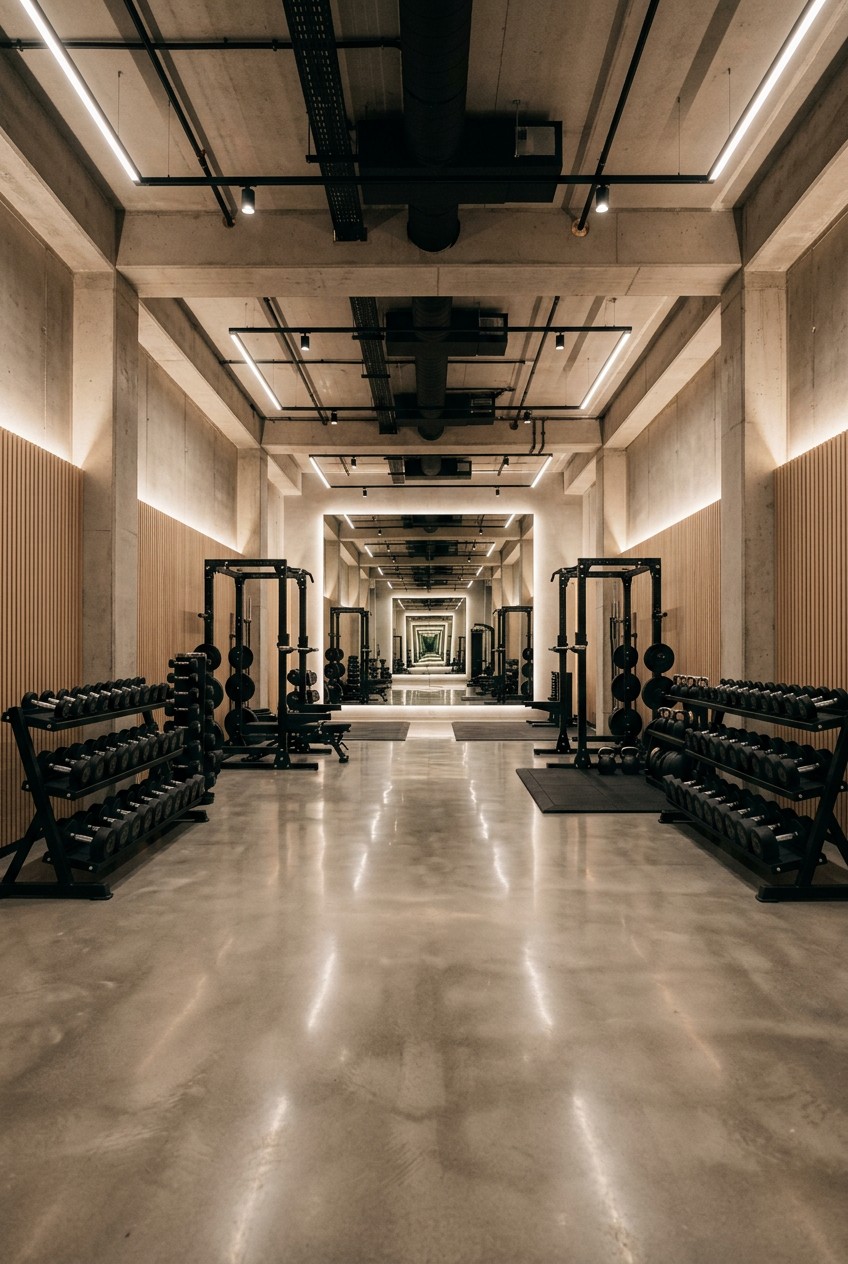
What’s Inside
- Ditch The Warehouse Lighting For A Better Fitness Gym Aesthetic
- Layer Your Flooring Like A Pro
- Strategic Mirror Placement Saves Your Form
- Purify The Air So It Doesn’t Smell Like A Locker Room
- Bring In Plants For A Natural Vibe
- Mount Digital Signage To Stay Focused
- Hang Custom Neon For Instant Energy
- Control The Noise With Acoustic Panels
- Give Your Equipment Room To Breathe
Last Tuesday at Costco, I caught my reflection in the security dome mirror and realized my home setup looked like a haunted house, not a place to build muscle. I tried fixing my fitness gym aesthetic for months before figuring it out. I slapped some cheap LED strips on the wall, dragged in a rusty bench, and called it a day. The result? I hated working out in there. The air smelled like old sneakers and damp cardboard. The harsh warehouse lighting gave me a headache before I even touched a barbell. I’m telling you this because nailing your fitness gym aesthetic isn’t just about making things look pretty for the camera. It’s about creating a space that actually makes you want to lift heavy things.
Most people get this completely wrong. They buy expensive squat racks but leave the bare, cracked concrete floor exposed, or they install overhead lighting that makes them look like a sick ghost in the mirror. When your environment feels off, your workouts suffer. You cut your sets short. You skip the accessory work. I’ve been there. I spent years lifting in depressing, cluttered, foul-smelling garages before I finally learned how to design a space that actually pulls me in and demands effort. If you’re tired of dreading your workouts because your space feels like a dungeon, I’m going to walk you through exactly how I fixed mine. We’ll cover the exact materials, the specific measurements, and the actual brands you need to make your space functional, safe, and visually aggressive. Let’s break down the nine things you need to change right now.
1. Ditch The Warehouse Lighting For A Better Fitness Gym Aesthetic

I used to think brighter was always better. I bought a pack of cheap, 5000K cool white fluorescent tubes at Walmart and mounted them directly over my lifting platform. It was a massive mistake. The light was so harsh and clinical, it felt like I was prepping for surgery instead of doing squats. Every time I looked in the mirror, the blue-tinted light washed out all my muscle definition and made me look exhausted and pale. If you want a proper fitness gym aesthetic, you’ve got to control the color temperature. Skip the harsh cool whites for your main lifting zones. Instead, I personally swear by adjustable LED fixtures.
You want warmer lights right around 2200K to 3000K in your stretching and recovery areas. This softer, amber glow actually signals your brain to relax. Then, for the high-energy zones where you’re pushing heavy weight, you bump it up to a crisp 4000K. You can easily achieve this with Philips Hue White and Color Ambiance smart bulbs. They cost exactly $44.98 each, but they let you shift the mood instantly from your phone. I tried this wrong for months before figuring it out. I was getting headaches from the glare bouncing off my barbell knurling. No exaggeration. Now, I keep the overhead lights slightly dimmed and rely on angled lighting to cast shadows that highlight muscle definition. It makes a massive difference in how you perceive your own progress, which directly impacts how hard you push your next set. Good lighting won’t lift the weight for you, but it absolutely changes your mindset before you grab the bar.
2. Layer Your Flooring Like A Pro

Flooring is the one place where being cheap will literally destroy your foundation. I learned this the hard way. A few years ago, I bought some flimsy, interlocking foam mats from Target for my garage. I was doing heavy deadlifts, dropped a 135 lb barbell, and heard a sickening crack. The thin foam did absolutely nothing to absorb the shock, and the concrete floor underneath shattered. The gritty concrete dust mixed with the sweat on the floor, and it was an absolute nightmare to clean. Don’t cut corners here. For basic cardio areas, a 6mm (1/4 inch) rubber roll is usually fine.
But if you’re setting up a free weight zone, you need 10mm to 12mm (3/8 to 1/2 inch) thickness to handle dumbbells up to 100 lbs. If you’re doing Olympic lifts or CrossFit where you regularly drop heavy bumper plates, you need serious protection. I recommend 18mm (3/4 inch) up to 40mm thick rubber tiles. I use Ecore Athletic rolled rubber. It runs about $3.50 per square foot, and it’s made from recycled materials. The texture is incredibly dense and grippy. When you drop a heavy dumbbell on it, you don’t hear a sharp, hollow smack. You just hear a dull, satisfying thud. The grip on your shoes is completely different, too. You feel planted and secure, which is exactly what you need when you’re grinding out a heavy, high-volume squat session. It pulls the whole room together visually, giving you that premium, commercial gym feel.
3. Strategic Mirror Placement Saves Your Form

Most people just lean a cheap, warped mirror against the wall and call it a day. I did exactly this. I bought a flimsy $15 door mirror and propped it up against my drywall. The plastic was so warped it gave me a funhouse distortion, making my legs look completely disproportionate. Even worse, it was sitting directly on the floor, so I had to crane my neck down awkwardly just to check my deadlift setup. The warped, funhouse distortion of thin plastic mirrors making you look squished is incredibly distracting. You can’t fix your posture if the mirror is lying to you. You might also like: 15 Cozy Aesthetic Morning Workout Routine That Are Totally Worth It
To build a space that actually helps your training, you need proper glass or high-quality acrylic mounted at the correct height. You want to install your mirrors at eye level, typically 5 to 6 feet from the floor. But if you’re in a smaller home setup, I highly suggest getting 36-inch by 60-inch acrylic mirrors. I use the Fab Glass and Mirror 36×60 frameless kit, which costs $149.99. The trick is to mount them exactly 12 inches off the baseboard. This height allows you to see your feet and check your squat depth without having to look at the floor. Pro tip: always leave at least a 1/8 inch gap between mirror panels. I didn’t do this my first time, and when the garage got hot during the summer, the mirrors expanded and cracked straight down the middle. Proper spacing keeps your reflection clean and your walls looking incredibly professional. You might also like: 20 Beautiful Home Gym Setup Ideas That Changed Everything

Jump Rope, Tangle-Free Rapid Speed Jumping Rope Cable with
Jump Rope punches above its price — 24 buyers rated it 4.5 stars. I would buy it again.
4. Purify The Air So It Doesn’t Smell Like A Locker Room

Nothing ruins a workout faster than walking into a room that smells like wet dog and stale onions. For the longest time, my training space was an absolute biohazard. I’d sweat through my shirts, leave my knee sleeves on the bench, and just let the room marinate in humidity. I tried covering it up by spraying cheap air freshener I grabbed at Kroger, but that just made the room smell like synthetic pine needles mixed with hot body odor. It was disgusting. You can’t just mask the smell. You have to eliminate the airborne particles. You need a heavy-duty air purification system. You might also like: 20 Gorgeous Easy Home Workout Ideas That Actually Work
I’m talking about HEPA filters that capture 99.97 percent of particles down to 0.3 microns. I finally invested in an ISO-Aire HEPA unit. It set me back $599.00, but the difference was immediate. The air actually feels crisp and light in your lungs when you’re gasping for breath after a heavy set. Once the air is clean, you can introduce intentional scent marketing. I honestly swear by peppermint oil before a heavy session. I pick up Edens Garden Peppermint essential oil for $12.95 (a 10ml bottle) and put five drops in a basic diffuser on my shelf. The sharp, icy hit of peppermint clears your sinuses instantly and wakes up your nervous system. For post-workout stretching, I switch to lavender oil to bring my heart rate down. It completely changes the vibe of the room.
5. Bring In Plants For A Natural Vibe

I used to laugh at the idea of putting plants in a weight room. It seemed completely out of place next to cast iron and chalk. I bought a cheap plastic fern at Sprouts once, threw it in the corner, and forgot about it. Within a month, it was covered in a thick layer of grey dust and looked absolutely pathetic. The dusty, brittle plastic made the room look cheaper, not better. Then I read about biophilic design and how real plants actually improve air quality and reduce stress. I decided to give it a real shot.
Experts recommend 6 to 8 plants per 270 square feet. I went out and bought three Costa Farms Snake Plants in 6-inch grower pots for $28.99 each. I placed them near the natural light coming from my small window. The difference in the room’s energy is hard to explain until you experience it. The waxy, dark green leaves add a massive pop of color against the matte black equipment. Snake plants are incredibly tough, too. You can forget to water them for three weeks, and they won’t die. They actively filter toxins out of the air while you sleep. Having living things in your training space breaks up the harsh, industrial feel of steel and rubber. It makes the room feel alive, which subconsciously gives you a little more energy when you’re dragging your feet before a brutal warmup.
6. Mount Digital Signage To Stay Focused
We’ve all done it. You set your phone on your water bottle to watch a form video or keep an eye on your rest timer. Last month, I was doing exactly that while getting ready for a heavy bench press. My foot clipped the bench, the water bottle tipped over, and my phone smashed face-first onto a metal weight plate. The screen shattered completely. Relying on your phone for your workout flow is a massive distraction anyway. You go to check your timer, and suddenly you’re reading a text message and losing your focus entirely.
To fix this, I installed a dedicated digital screen on the wall. I bought a TCL 43-inch Class S4 4K LED Smart TV for $219.99. I don’t use it to watch movies. I use it strictly for dynamic digital signage. You can run systems like FRAMEN, which cost around $200 to $1000 depending on the setup, to display a massive interval timer, your daily programming, or even just motivational visuals. Having a giant, glowing red timer flashing on the wall across the room holds you accountable. When that clock hits zero, you can’t ignore it. You don’t have to squint at a tiny phone screen with chalky hands. It keeps your head in the game and makes the space look incredibly professional, like a high-end private training facility. The bright, crisp numbers of a digital timer flashing red across the room is the ultimate motivator.

LIVIKEY Fitness Tracker Watch with Heart Rate Monitor
If you want something that just works, LIVIKEY Fitness Tracker Watch with Heart Rate Monitor is a safe bet (58 reviews, 4.5 stars).
7. Hang Custom Neon For Instant Energy

A blank, white drywall background is the absolute enemy of a good workout environment. I tried to fix my boring walls by taping up some old supplement posters I got for free. The edges curled up, the tape peeled the paint off, and it just looked trashy. If you want to completely change the mood of the room with one single item, you need a custom LED neon sign. I ordered a 24-inch wide Custom Neon LED sign that says ‘Rise & Grind’ in a deep, saturated red. It cost exactly $250.00.
When I walk in at 5 AM and it’s pitch black outside, I flip that sign on. The warm, electric hum and the harsh red glow washing over the matte black squat rack instantly flips a switch in my brain. It creates deep shadows and highlights the knurling on the barbells. It’s also the perfect backdrop if you like filming your lifts to check your form. The contrast between the bright neon and the dark equipment looks incredible on camera. Just avoid buying those ultra-cheap, battery-powered neon signs from the impulse aisle. Tried stringing up cheap Christmas lights from Walmart once, and it looked like a frat house. Invest in a proper, plug-in LED sign mounted securely to the studs. It gives the room an aggressive, gritty personality that paper posters just can’t match.
8. Control The Noise With Acoustic Panels

This is the most overlooked part of building a home training space. When I first set up my heavy bag and deadlift platform, the acoustics were a nightmare. The room was essentially a giant concrete box. Every time I dropped a 45 lb bumper plate, the sound echoed so violently it actually hurt my ears. It sounded like a bomb going off inside a tin can. My neighbors complained twice in one week. I couldn’t focus on my lifting because I was terrified of making too much noise.
You can’t train hard if you’re trying to set heavy weights down gently. To fix this, you’ve got to manage the acoustics. Thick 40mm flooring helps, but you need to treat the bare walls. I bought a 12-pack of Auralex Studiofoam Wedges (24×24 inches, 2-inch thick) for $159.99. I mounted them directly behind my squat rack and along the ceiling above the platform. The change in the room’s sound profile is shocking. You lose that harsh, high-pitched ringing. Now, when I drop a heavy barbell, the sound is a deadened, tight thud that gets absorbed instantly. The deadened, satisfying thud of a heavy dumbbell hitting the floor when the acoustics are dialed in is incredible. You don’t flinch. You just lift. It makes the room feel smaller, cozier, and much more private. You can blast your music, grunt, and drop weights without feeling like you’re broadcasting your workout to the entire neighborhood.
9. Give Your Equipment Room To Breathe

The fastest way to ruin your space is to cram too much gear into it. I’m completely guilty of this. I used to buy every random kettlebell and resistance band I saw on sale at Whole Foods and just leave them scattered on the floor. One morning, I was backing out of a heavy barbell squat, tripped over a rogue 35 lb kettlebell, and nearly blew out my knee. I stubbed my toe so hard on the cold, knurled steel handle that my vision actually blurred. Clutter is dangerous, and it looks terrible.
You need strict traffic flow. Expert guidelines say you must have wide walkways of at least 1.5 to 2 meters (5 to 6.5 feet) between your key workout zones. More importantly, you need a minimum of 2 meters (6.5 feet) of completely clear space around your squat rack. To achieve this, you’ve got to get your gear off the floor. I finally dropped the money on a Rogue Fitness 3-Tier Mass Storage System for $495.00. It holds my bumper plates, my dumbbells, and my kettlebells all in one compact footprint. When your floor is clear, the room instantly looks twice as big. You don’t feel claustrophobic when you’re trying to do walking lunges. A clean, organized space clears your mind so you can focus entirely on the physical pain of the workout, not the intense frustration of tripping over your own scattered equipment.
Look, building the right environment takes time and money, but it’s the best investment you can make in your own physical health. I’ve trained in terrible, cluttered spaces, and I’ve trained in dialed-in, professional-grade rooms. The difference in my motivation and my actual strength gains is night and day. Stop settling for a depressing setup. Take just one of these steps this weekend. Go buy the right lights, order some decent flooring, or finally clean up your clutter. I promise you’ll feel the difference the second you step up to the bar. If you found this breakdown helpful, make sure to pin this article so you can reference the exact measurements and brands when you’re ready to upgrade your space.

Jump Rope, Tangle-Free Rapid Speed Jumping Rope Cable with
A dependable everyday pick — Jump Rope pulls in 24 ratings at 4.5 stars. Not flashy, just solid.
Frequently Asked Questions
How much does it cost to improve my fitness gym aesthetic?
It depends on your priorities. You can upgrade your lighting for under $50 with smart bulbs, or spend $500+ on commercial storage racks. Start with lighting and thick rubber flooring first.
What lighting is best for a fitness gym aesthetic?
Avoid harsh 5000K cool white lights. Use adjustable LED bulbs set to 4000K for high-energy lifting zones, and warmer 2200K to 3000K lights for stretching and recovery areas to reduce glare.
Do I really need mirrors for my fitness gym aesthetic?
Yes, but not just for looks. Large, undistorted acrylic or glass mirrors mounted 12 inches off the floor allow you to check your form safely during heavy lifts like squats and deadlifts.
How do I make my fitness gym aesthetic smell better?
Don’t just mask odors with cheap sprays. Invest in a true HEPA air purifier to remove airborne sweat particles, then use a diffuser with peppermint or lavender essential oils for a clean scent.
1 thought on “9 Aesthetic Fitness Gym for Every Budget”