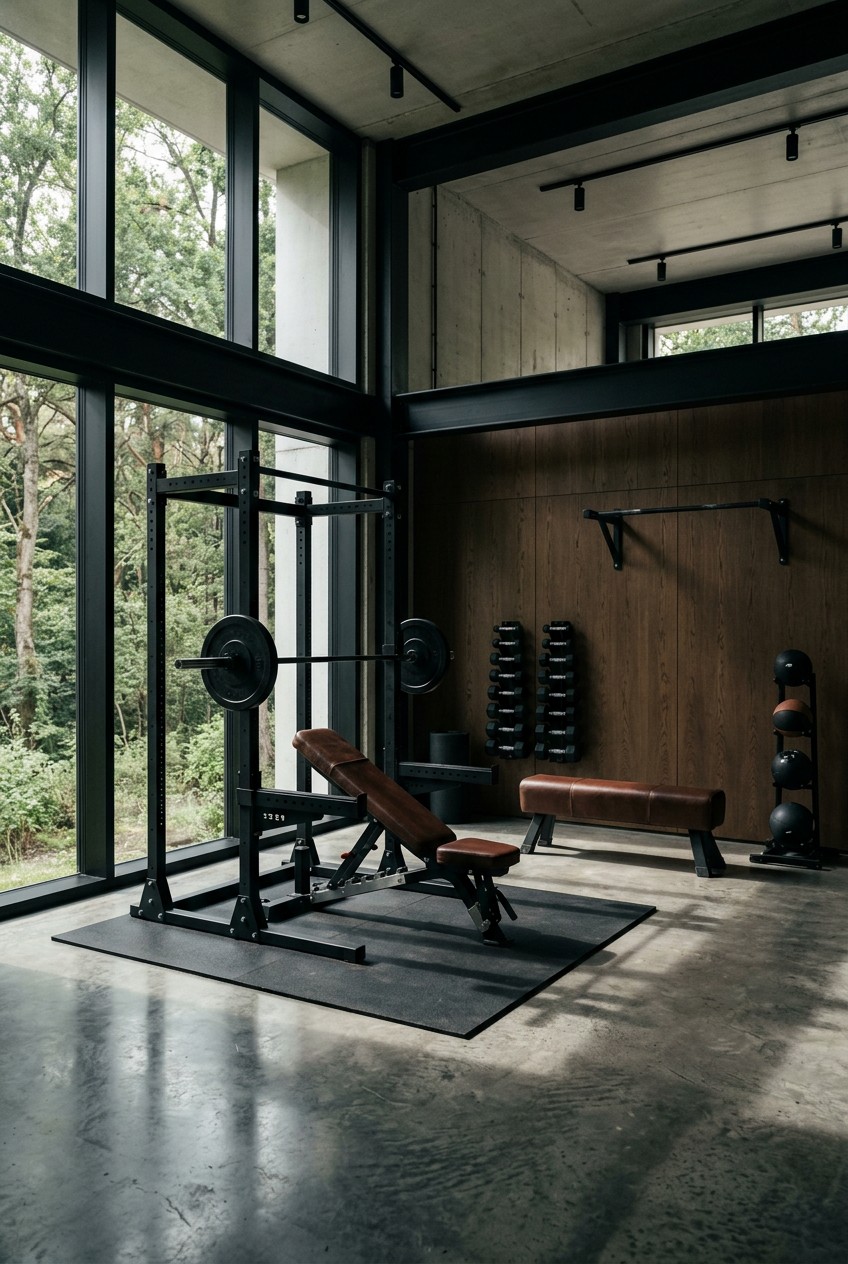
What’s Inside
- Dynamic Zoning Makes Or Breaks Your Gym Design Interior
- Spacing Out Your Gear So You Don’t Die
- Lighting That Doesn’t Make You Look Like A Zombie
- Air Quality And HVAC Realities You Can’t Ignore
- Adding Plants For A Natural Vibe
- The Recovery Zone Is Mandatory Now
- Smart Tech That Actually Works For You
- Heavy-Duty Storage To Stop Tripping Over Dumbbells
- Stop Messing Up Your Flooring And Mirrors
Last Tuesday at Target, I bought a cheap $14.99 10-pound kettlebell, rushed home, tripped over a rogue yoga mat in my cluttered garage, and nearly shattered my kneecap on a concrete step. That specific, blinding, throbbing pain taught me a brutal lesson about proper gym design. If your gym interior sucks, you won’t just skip workouts. You’ll hate the space, and you might actually get hurt. I spent years training in dark, cramped, foul-smelling rooms because I thought suffering was part of the grind. It isn’t. A poorly laid out room drains your energy before you even pick up a weight. You walk in, smell stale rubber, see a mess of iron, and your brain wants to quit. Let’s fix that nonsense. I’ve wasted thousands of dollars doing this wrong. I bought the wrong lights, the wrong paint, and the wrong mats. I’m going to walk you through exactly how to set up a space that pulls you in. These are the layouts, measurements, and products I use to build rooms that work. No exaggeration.
1. Dynamic Zoning Makes Or Breaks Your Gym Design Interior

Rigid rooms are dead. You can’t just throw a treadmill in a corner and call it a day. I tried this for months before figuring it out. I shoved all my gear against one wall, and my garage felt like a claustrophobic storage unit. I hated going in there. The smell of old rubber and stagnant air just hung around that tight corner. Now, I’m obsessed with what the industry calls the power of pods. This means creating dedicated, flexible zones for specific movements. You need a setup that flows naturally from one exercise to the next. I personally swear by integrating a Shadow XD cable rack. It costs exactly $1,299.00, but it acts as a central hub for a functional training pod. You can do heavy cable pulls, then take two steps back for mobility work without hitting a wall.
Use visual cues to separate these pods. I bought a 4-gallon bucket of bright blue epoxy paint for $115.50 to mark off my stretching zone. It visually separates the heavy lifting area from the cool-down spot. When you segment the room, your brain shifts gears automatically. You aren’t just standing in a sweaty room. You’re moving through a structured workout. Skip the chaotic, everything-everywhere layout. It creates mental friction. You want smooth transitions. I even use different colored 24-inch by 24-inch rubber tiles to mark the boundaries of my lifting platform. It’s a small detail, but it changes how you interact with the floor plan. You’ll stick to your routine when the room tells you where to go.
2. Spacing Out Your Gear So You Don’t Die

Inadequate spacing is a massive mistake. I learned that the hard way last winter. I was doing heavy walking lunges and smashed my shin directly into the sharp metal pedal of my stationary bike. The cold, hard metal scraped right down my shin bone. The bruise was purple, yellow, and black for three weeks. You must implement precise equipment spacing for safety. Ensure a strict minimum of 3 feet (0.9 meters) of clearance on either side of cardio machines like treadmills or ellipticals. You also need 6 to 7 feet (1.8 to 2.1 meters) of clear space behind them. If you trip on a treadmill belt moving at 8 miles per hour, you need room to fall without cracking your skull on a dumbbell rack. Seriously.
For strength training areas, allocate 20 to 50 square feet per piece of equipment. Functional training needs 20 to 30 square feet per person. I bought a pack of heavy-duty commercial mats at Costco for $39.99 last month just to visually measure out my 30-square-foot kettlebell zone. They smell like fresh tires and weigh 40 pounds per mat, but they lock my space in perfectly. If you pack things too tight, you’ll feel cramped and your form will suffer. You won’t extend fully on lateral raises because you’re scared of hitting a wall. Give yourself room to breathe. It’s better to have three pieces of equipment with proper spacing than five pieces crammed together like a bad game of Tetris.
3. Lighting That Doesn’t Make You Look Like A Zombie

Lighting dictates your energy levels. If you use cheap, warm, dim bulbs, your gym will feel like a sleepy living room. I used to train under a single, flickering 60-watt yellow bulb. It made me yawn between sets, and it cast this sickly, yellow pallor over everything. I looked like a sick Victorian child in the mirror. You need specific lux levels and color temperatures to trigger alertness. For high-energy zones like the weight room, target around 500 lux with a crisp, cool white color temperature of 4000K to 5000K. This mimics bright daylight. It wakes up your nervous system.
I swapped my old fixtures for a set of Barrina LED T5 Shop Lights. I grabbed an 8-pack online for $45.99. They snap together with these little 3-inch connector cables. Installation took me maybe 20 minutes. The difference is insane. Suddenly, I could see the actual definition in my muscles, and the room felt alive. Ensure your Unified Glare Rating (UGR) is no higher than 22. You don’t want blinding spots when you’re staring at the ceiling during a heavy bench press. Keep the Color Rendering Index (CRI) at 80 or above so things look natural. For your yoga or recovery corner, drop the intensity. I bought a small, dimmable floor lamp at Walmart for $12.99. I keep it at 3000K and 200 lux. It gives off a soft, warm glow that tells my brain the hard work is over. Don’t use the same harsh light for deadlifts and deep breathing. You might also like: 15 Stunning Room Home Workout Ideas That Make a Real Difference

Jump Rope, High Speed Weighted Jump Rope
Honestly, Jump Rope surprised me — sturdier than it looks in the photos, and over 4 buyers gave it 4.5 stars.
4. Air Quality And HVAC Realities You Can’t Ignore

Gyms generate a disgusting amount of heat, humidity, and body odor. A standard home AC unit won’t cut it. I tried masking the smell of stale sweat for a year. I poured six drops of a $14.99 eucalyptus essential oil I bought at Sprouts into a cheap plastic diffuser. It mixed with the smell of my unwashed knee sleeves, creating a scent that made my stomach turn. It smelled like a koala died in a locker room. You need high-capacity ventilation. If you’re building out a serious space, look into a Dedicated Outdoor Air System (DOAS) or an Energy Recovery Ventilator (ERV). You need frequent air exchanges to pull the stink out. You might also like: 15 Brilliant Dark Basements Home Gym Setup Ideas Worth Trying This Year
Keep your humidity strictly between 40 and 60 percent. Anything higher, and your expensive cast iron plates will start rusting. I bought a Midea 50-pint dehumidifier for $199.00. It hums quietly in the corner, pulling out two gallons of murky water every three days. Emptying that bucket is satisfying. Use MERV 13 or higher filters in your vents. They catch the microscopic dust and chalk particles that irritate your lungs during heavy breathing. If you’re doing intense cardio, you’re sucking in massive amounts of air. You want that air to be clean. Don’t cheap out on airflow. A stagnant, humid room will crush your motivation faster than a heavy squat day. Good air quality keeps you fresh, keeps the equipment from degrading, and makes the space pleasant to exist in. You might also like: 15 Beautiful Photoshoot Home Workout Ideas to Steal Right Now
5. Adding Plants For A Natural Vibe

This sounds like hippy nonsense, but biophilic design is a massive trend, and it works. Connecting with nature lowers your heart rate and reduces cortisol. You don’t want your gym feeling like a sterile hospital or a damp dungeon. Bring life into the room. The sweet spot is 6 to 8 medium-sized indoor plants per 25 square meters. Last Sunday, I went to Trader Joe’s and bought three snake plants for $24.99 each. They sit in these cheap white ceramic pots. The soil is dry, but the thick, waxy green leaves refuse to die.
I put them in the empty corners of my garage gym. They don’t need much sunlight, and they naturally filter the air. The visual pop of green against black rubber mats softens the room. Incorporate natural textures too. I nailed some cheap, raw pine shiplap boards to one accent wall. A bundle of 6 boards cost me $32.48 at a local lumber yard. The faint smell of real wood mixed with the visual warmth changes the whole atmosphere. Maximize whatever natural light you have. If you have a window, clean it. Don’t block it with a massive squat rack. If you train in a windowless room, diffuse a very light, natural scent like cedar or pine. Just a few drops. It tricks your brain into feeling less confined. You’ll want to spend an hour in there instead of rushing through your sets.
6. The Recovery Zone Is Mandatory Now

Recovery is no longer a luxury. It’s a core requirement for a modern gym layout. If you just finish your last set and walk out, you’re leaving progress on the table. You need a dedicated physical space for this. I used to just stretch on my dirty living room rug while watching TV. I’d usually skip it because the friction of moving rooms was too high. Now, I have a strict 5-foot by 5-foot recovery bay built right into my floor plan. You need the right tools permanently stationed there. I keep my Hyperice Hypervolt 2 massage gun sitting on a small wooden shelf.
I paid $199.00 for the Hypervolt, and it’s worth every penny for tight calves. The matte black rubber grip feels heavy and premium in your hand. When you turn it on level 3, the percussion shakes your vision. Right below it, I have a TriggerPoint GRID foam roller that cost $34.99. It has these dense, hollow plastic grids that dig into your IT band like a physical therapist’s elbow. When these tools are visible and accessible in a designated calm zone, you actually use them. Consider adding a small red light therapy panel. I bought a basic Hooga 300W panel for $119.00. I stand in front of it for 10 minutes post-workout. The warm, red glow is relaxing. Keep this area quiet. No heavy metal music. No clanking plates. This zone is about bringing your nervous system back down to baseline. Trust me.

Pull Up Assistance Bands
Pull Up Assistance Bands has been one of the most consistently praised picks in this category. 424 reviewers averaged 4.5/5.
7. Smart Tech That Actually Works For You

Technology should fade into the background. It needs to be infrastructure, not a gimmick. I used to bring my laptop into the gym to track my spreadsheets. I’d drop sweat on the keyboard and waste 5 minutes between sets scrolling the internet. It was a disaster. Now, I use smart tech. Implement a wall-mounted tablet running an AI-powered workout planner. Virtuagym’s AI coach is fantastic for generating quick, adaptable routines without thinking. I mounted a $329.00 base model iPad to the wall using a $25.99 magnetic case. I just tap the glass, see my sets, and get to work.
Ensure your setup plays nicely with your wearables. My Garmin Forerunner 265 syncs automatically. The silicone strap gets sweaty, but the bright AMOLED screen shows my heart rate instantly. I don’t have to push buttons. If you hate indoor cardio, consider an immersive virtual reality headset. I bought a Meta Quest 3 for $499.00 specifically for stationary bike sessions. The white plastic headset is a bit heavy on the cheekbones, but once you tighten the fabric strap, you’re instantly in a different world. You can ride through virtual mountains instead of staring at a blank drywall. It eliminates the boredom of a 45-minute Zone 2 cardio session. The key is reducing friction. Your tech should tell you what to do, track your effort, and get out of the way. If you have to spend 10 minutes pairing Bluetooth devices before a workout, your tech setup is failing you.
8. Heavy-Duty Storage To Stop Tripping Over Dumbbells

Clutter is a safety hazard. I can’t count how many times I’ve stubbed my toe on a stray 45-pound plate left on the floor. It hurts like hell. You need heavy-duty, organized storage solutions. This isn’t just about making the room look pretty. It’s about preserving your floor space and your ankles. Invest in commercial-grade storage. I finally bought the Rogue Fitness 3-Tier Mass Storage System. It cost me $405.00, plus a ridiculous amount for shipping, but it holds everything. The powder-coated steel feels rough like sandpaper. It doesn’t chip when you aggressively rack a 50-pound dumbbell.
Kettlebells, medicine balls, and dumbbells all have a specific home now. If you have barbells, get them off the floor immediately. I installed the PRx Performance Hanging Barbell Storage rack on my wall. It was $149.00. It’s laser-cut steel with a plastic liner so it doesn’t scratch the knurling on my Ohio Bar. It holds three bars vertically, taking up zero square footage. Use plate trees for your bumper plates. A basic Titan Fitness plate tree costs around $119.99. When every single piece of gear has a designated slot, cleaning up takes two minutes. You won’t start your next workout frustrated by a messy room. A clean, organized space respects the work you’re about to put in. Skip the cheap plastic bins. They crack under heavy weights. Buy heavy gauge steel once, and you’re set for life.
11. Stop Messing Up Your Flooring And Mirrors

Mirror placement and flooring choices ruin more gyms than bad equipment. Most people get this totally wrong. They buy cheap, squishy puzzle mats and slap mirrors on every wall. I did this. The squishy mats ruined my squat stability, and the fun-house mirrors made me dizzy. For heavy weightlifting, you need dense, impact-absorbing rubber. I bought 8-millimeter thick Regupol rolled rubber flooring. It runs about $89.00 per roll. It comes in these massive 4-foot wide rolls. Unrolling it takes two people because it weighs a ton. But once it’s down, it’s solid. It grips the soles of my flat lifting shoes perfectly.
I bruised my knees badly doing Turkish get-ups on thin, cheap mats once. I had to buy a $12.99 tube of arnica cream at Whole Foods to deal with the swelling. The white cream smelled faintly of mint and stung my bruised skin. It was a stupid tax for buying cheap foam mats. Never again. For mirrors, use floor-to-ceiling glass only where you need to check form. Put them in the free weight zone. Do not put them directly in front of cardio equipment. Staring at yourself sweating on a treadmill for 45 minutes is agonizing and causes weird self-consciousness. Angle your cardio machines toward a window or a blank wall instead. Mirrors also create the illusion of a larger space, so use them to bounce light around from your windows. Just be intentional. A mirror is a tool, not cheap wallpaper.
If you implement even half of these tips, your gym design interior will change how you train. You won’t dread walking into your workout space anymore. I’ve made all the expensive mistakes so you don’t have to. Invest in the right lighting, clear out the clutter, and give yourself room to move. I personally guarantee you’ll hit PRs just because you finally feel comfortable in your own space. Pin this guide for later, share it with a friend who has a messy garage gym, and let’s get to work.
Frequently Asked Questions
What is the best lighting for a home gym?
You want bright, cool lighting for lifting. Target 300 to 500 lux with a color temperature of 4000K to 5000K. This mimics natural daylight and wakes up your nervous system. I use cheap LED shop lights to get this exact effect.
How much space do I need between gym equipment?
Always leave a minimum of 3 feet of clearance on the sides of cardio machines. You need 6 to 7 feet of clear space behind treadmills for safety. For strength gear, plan for 20 to 50 square feet per machine so you aren’t cramped.
Why should I add plants to my workout room?
Biophilic design lowers stress and makes the room feel less like a dungeon. Aim for 6 to 8 low-maintenance indoor plants per 250 square feet. Snake plants are perfect because they survive in low light and help filter the stale air.
What colors are best for a fitness space?
Use stimulating colors like power red or fiery orange for heavy lifting zones to boost your heart rate. For recovery and yoga spaces, stick to calming blues or greens. Paint is the cheapest way to completely alter your mental state during a workout.
