What’s Inside
- Prioritize a Dynamic Warm-up (Even if You Hate It)
- Master the Full Range of Motion Squat for a Real Leg Workout For Men
- Integrate Unilateral Training with Bulgarian Split Squats
- Don’t Neglect Your Posterior Chain with Romanian Deadlifts (RDLs)
- Incorporate Glute-Ham Raises (GHRs) for Comprehensive Hamstring Development
- Implement Progressive Overload Consistently
- Embrace Eccentric Training for Enhanced Muscle Growth
- Optimize Your Post-Workout Nutrition with Quality Protein
- Make This Leg Workout For Men Fit Your Schedule
Last Tuesday at a cramped LA Fitness, I ripped the crotch out of my favorite gym shorts trying to squat cold. That embarrassing sound echoing off the mirrors is exactly why I’m writing this guide to a reliable leg workout for men. You don’t need a massive commercial gym or a $200 custom leather weightlifting belt to build impressive quads and hamstrings. I’ve spent years making every mistake in the book, from ego-lifting dangerous amounts of weight to ignoring my hamstrings until they cramped up during a pickup basketball game. Building strong legs isn’t about showing off. It’s about creating a foundation for your body, protecting your joints as you age, and just looking balanced in a pair of shorts. I’m going to break down the exact movements, cheap gear, and techniques I use to thrash my lower body. We’ll cover everything from warm-ups to post-workout nutrition. Grab a water bottle, clear some space in your garage, and let’s get into the heavy lifting.
1. Prioritize a Dynamic Warm-up (Even if You Hate It)

I tried skipping warm-ups for months because I thought it was a waste of time. I’d walk into the gym, slap two plates on the bar, and wonder why my knees sounded like crunching gravel. Last November, that stupidity caught up with me in the form of a sharp, stabbing pain under my right kneecap that sidelined me for three weeks. Before diving into heavy lifts, you absolutely must prepare your muscles and joints with dynamic movements. Skipping warm-ups is a massive mistake that’ll eventually lead to injury and derail your gains. I swear by spending five to ten minutes getting my blood flowing before I even look at a barbell. Learned that the hard way.
You need to incorporate specific exercises like leg swings. Do 10 to 15 reps per side, swinging your leg forward and backward to open up those tight hip flexors. Follow that up with squat-to-stands and Cossack squats to improve your mobility. I use a cheap set of Up&Up resistance bands I grabbed at Target for exactly $14.99. I wrap the medium-tension green band around my thighs just above the knee and do lateral band walks until my glutes are burning. Think of this like warming up the oil in a cold car engine. It forces synovial fluid into your joints and physically prepares your muscle fibers for the work ahead. Don’t skip this. You aren’t saving time by jumping straight into squats. You’re just begging for a torn meniscus.
2. Master the Full Range of Motion Squat for a Real Leg Workout For Men

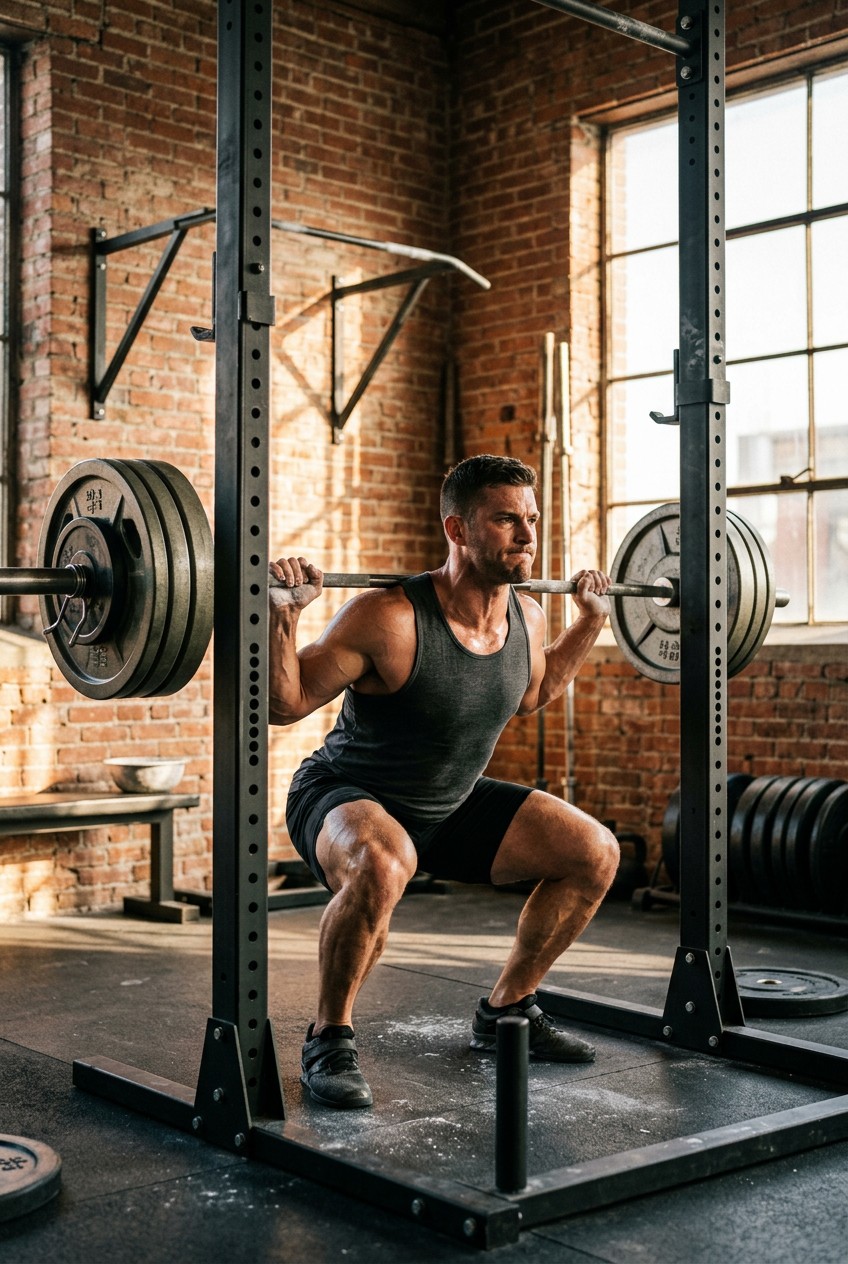
Ego-lifting is for clowns. I used to be one of them, loading up the bar with 315 pounds and barely bending my knees. I thought I was strong until a trainer pointed out I was doing a quarter-squat at best. Don’t ego-lift by cutting your squat depth short. Dr. Milo Wolf, a highly respected sports scientist, emphasizes that legs grow best when trained in the stretch position. Full squats, where your thighs break below parallel, are better for strength and muscle-building than shallow half squats. Aim to use a weight that allows you to achieve at least a 90-degree bend in your knees. If your ankle mobility allows it, go even deeper. Ass to grass, as they say.
To support my knees during these deep squats, I used to buy expensive gear, but now I just use a pair of Gold’s Gym neoprene knee sleeves I found at Walmart for $12.88. They smell like cheap rubber, but they keep the joint warm and provide just enough compression. When you descend into the squat, take a deep breath into your belly, brace your core like you’re about to take a punch, and control the weight on the way down. Drive through your mid-foot on the way up. If you’re doing this at home without a barbell, grab a heavy dumbbell or kettlebell and perform goblet squats. Hold the weight tight against your chest, keep your torso upright, and sink your hips down between your heels.
3. Integrate Unilateral Training with Bulgarian Split Squats

Honestly, this changed how I train my lower body forever. The Bulgarian split squat is a powerhouse for addressing muscular imbalances. Most of us favor one leg, and standard squats allow your dominant side to take over. Unilateral training forces each leg to carry its own weight. Perform 3 to 4 sets of 8 to 12 repetitions per leg. To execute this correctly, place your rear foot with the laces facing down on a bench or chair. Ensure your front foot is flat on the floor and your weight is centered over your mid-foot.
Most people get this wrong by pushing off their back leg. Your back leg is just a kickstand. 90 percent of the work should be happening in your front leg. For a glute bias, lean your torso slightly forward as you drop down. For a quad bias, keep your torso upright and drive your front knee forward over your toes. I do these in my garage using a pair of Bowflex SelectTech adjustable dumbbells that cost me $429.00, resting my back foot on a cheap plastic step stool from Target that cost $9.00. The burn is intense. By the eighth rep, your quad will feel like it’s filled with battery acid, and sweat will be stinging your eyes. Push through it. This is where the real growth happens. You might also like: 15 Stunning Room Home Workout Ideas That Make a Real Difference

OLIXIS Adjustable Weight Bench for Full Body Strength
If you want something that just works, OLIXIS Adjustable Weight Bench for Full Body Strength Training is a safe bet (31 reviews, 4.5 stars).
4. Don’t Neglect Your Posterior Chain with Romanian Deadlifts (RDLs)

Your posterior chain—the muscles on the backside of your body—is the engine of your athletic performance. RDLs are crucial for hamstring and glute development. I learned this the hard way two years ago. I was doing RDLs with awful form, rounding my lower back like a scared cat, and I severely tweaked a lumbar muscle. The pain was blinding. Now, I treat the hip hinge with respect. Aim for 3 to 4 sets of 6 to 10 reps, focusing on pushing your hips backward rather than just bending over. You might also like: 20 Inspiring Journal Home Workout Ideas You Haven’t Thought Of
Keep a soft bend in your knees. Lead the movement with your hips moving toward the wall behind you, and maintain the barbell or dumbbells right against your legs. The weight should descend somewhere between your knee and mid-shin, depending on your personal flexibility. You should feel a deep stretch in your hamstrings, like a thick rubber band being pulled tight. Never let your lower back round. To keep my grip secure, I use a bottle of liquid chalk I bought from Sprouts for $8.99. It smells like alcohol when you squirt it out, but it dries in seconds and locks your hands onto the bar so you can focus on your hamstrings instead of your failing grip. You might also like: 20 Gorgeous Easy Home Workout Ideas That Actually Work
5. Incorporate Glute-Ham Raises (GHRs) for Comprehensive Hamstring Development

This is the secret weapon that most average gym-goers ignore. The Glute-Ham Raise is unparalleled in building bulletproof hamstring strength because it works the muscles through their full range of motion at both the knee and the hip joints simultaneously. Perform 3 sets of 8 to 15 repetitions. GHRs are an eccentric exercise, meaning they emphasize the lengthening phase of the muscle contraction. This eccentric overload contributes to muscle mass and raw strength. They also engage your core and lower back, promoting a powerful posterior chain.
If you don’t have a dedicated GHR machine, do Nordic hamstring curls on the floor. I tuck my ankles under a heavy couch and use a thick, rolled-up B Yoga mat I bought at Whole Foods for $29.99 to cushion my knees. A common mistake is placing your knees too high on the pad or bending at the hips instead of the knees, which can lead to nasty hyperextension. Keep your body in a straight line from your knees to your shoulders. Lower yourself to the floor as slowly as possible. Catch yourself with your hands at the bottom, then push back up. Your hamstrings will cramp the first few times you try this. That means it’s working.
6. Implement Progressive Overload Consistently

You can’t do the exact same workout with the same weights every week and expect your legs to grow. To stimulate muscle growth, you must challenge your muscles. This means regularly increasing the weight, adding more repetitions, doing extra sets, or decreasing your rest times. As Dr. Milo Wolf states, progressive overload is a fundamental principle for muscle hypertrophy. If you aren’t tracking your lifts, you’re just guessing.
I track every workout in a little black Moleskine notebook I picked up at Kroger for $19.50. It’s covered in chalk dust and sweat, but it holds all my data. If I squatted 225 pounds for 8 reps last week, my goal this week is to hit 9 reps, or bump the weight up to 230 pounds. You have to force the adaptation. Your body is lazy and won’t build metabolically expensive muscle tissue unless it’s given a compelling reason. Write down your numbers. When the workout gets hard and you want to quit at 8 reps, looking at that notebook and knowing you need 10 reps to beat last week’s record will give you the mental push you need to grind out those final repetitions.

Yoleo Adjustable Weight Bench
Yoleo Adjustable Weight Bench has been one of the most consistently praised picks in this category. 974 reviewers averaged 4.5/5.
7. Embrace Eccentric Training for Enhanced Muscle Growth

Most guys waste the lowering phase of their exercises. They’ll struggle to lift the weight, then let gravity yank it back down. Focus on the negative or lowering phase of your lifts. For squats, split squats, and RDLs, you need to control the eccentric portion for a strict 3 to 5 seconds. This slow, controlled descent causes micro-tears in the muscle fibers, which leads to greater damage and subsequent hypertrophy when you recover.
I time my eccentric phases using a cheap, indestructible Casio digital watch I bought at Walmart for $18.50. The beeping keeps me honest. When you drop into a squat, count: one-one-thousand, two-one-thousand, three-one-thousand, four-one-thousand, then violently explode back up. The Glute-Ham Raise we talked about earlier is inherently an eccentric exercise, making it effective for building dense muscle. Eccentric training hurts. It causes a deep, burning ache that lasts for days. But if you want your jeans to fit tighter around your thighs, you have to embrace that pain. Don’t just drop the weight. Fight gravity every inch of the way down.
8. Optimize Your Post-Workout Nutrition with Quality Protein

You can train until you puke, but if you don’t feed your muscles afterward, you’re wasting your time. Consume 20 to 30 grams of protein within an hour after your workout to kickstart repair. I rely on a fast-absorbing whey protein. I use Myprotein Impact Whey Protein (I usually buy the 2.2 lb bag for $39.99). I mix one scoop with 1 cup of Trader Joe’s unsweetened vanilla almond milk ($2.29) and a 1/2 cup of frozen mixed berries from Costco ($10.99 for a massive bag).
Skip the fat-free stuff. It tastes like wet cardboard. Add a tablespoon of real peanut butter to get some healthy fats and extra calories if you’re trying to bulk. I learned the hard way not to mix my shakes in a cheap shaker bottle. Last summer, the lid popped off in my car, spraying chocolate protein milk all over my seats. The smell in July was horrifying—no exaggeration. Now I use a blender at home. Drink your shake, eat a solid meal with complex carbohydrates like sweet potatoes within two hours, and drink a gallon of water throughout the day. Your recovering leg muscles are desperate for glycogen and amino acids. Give them the fuel they need to rebuild thicker and stronger.
9. Make This Leg Workout For Men Fit Your Schedule

The best leg workout is the one you actually do. You don’t need two hours in a gym to get results. If you’re traveling or stuck at home, you can adapt these movements. Bodyweight squats, walking lunges, and single-leg glute bridges require zero equipment and can destroy your legs if you use the slow eccentric tempos we discussed.
When I travel, I pack a TRX Go Suspension Trainer I bought for $109.95. It weighs almost nothing, and I can hang it over any hotel door. I use it to do assisted pistol squats and deep, suspended lunges. If you don’t want to spend that much, buy a simple heavy-duty door anchor from Amazon for $6.99 and loop your Target resistance bands through it for hamstring curls and glute kickbacks. The point is to eliminate excuses. You don’t need a perfectly calibrated machine to create muscle tension. You just need gravity, some floor space, and the mental toughness to push your legs past their comfort zone. Stay consistent, track your progress, and watch your lower body transform over the next twelve weeks.
That wraps up my protocol for building massive legs anywhere. I’ve tested these methods for years, and I promise you that if you stick to this routine, eat your protein, and stop skipping the warm-up, you’ll see serious growth. If you found this breakdown helpful, save or pin this article so you can reference the rep ranges during your next lower body day. Now go drink some water and stretch out those hamstrings.

FLYBIRD WB2 Weight Bench
FLYBIRD WB2 Weight Bench punches above its price — 215 buyers rated it 4.5 stars. I would buy it again.
Frequently Asked Questions
How often should I do this leg workout for men?
Aim for twice a week. Your legs need about 48 to 72 hours to recover fully. Hitting them twice a week ensures you’re getting enough volume for muscle growth without risking overtraining or joint pain.
Can I do a leg workout for men without weights?
Yes. You can absolutely build strength using bodyweight exercises like deep squats, walking lunges, and plyometric jumps. Just focus on slowing down the eccentric phase to three or five seconds to maximize muscle tension.
What is the best exercise in a leg workout for men?
The full range of motion barbell squat is the undisputed king. It hits your quads, glutes, and core all at once. If you don’t have a barbell, Bulgarian split squats are a close second for building balanced strength.
Why do my knees hurt during my leg workout?
You’re probably skipping your dynamic warm-up or letting your knees cave inward during squats. Always spend five to ten minutes doing leg swings and Cossack squats to lubricate the joints before you load up any heavy weight.
