What’s Inside
- Prioritize Safety Flooring with Specific Thicknesses
- Anchor Everything to the Studs
- Install a Swedish Wall Ladder for Versatility
- Add Heavy-Duty Ceiling Hooks for Swings in Your Indoor Jungle Gym Playroom
- Incorporate a Bouldering Wall with Textured Holds
- Use Crash Pads for the High Fall Zones
- Hang a Cargo Climbing Net for Core Strength
- Set Up a Modular Obstacle Course
- Install a Pull-Up Bar That Holds Adults
- Keep the Indoor Jungle Gym Playroom Ventilated
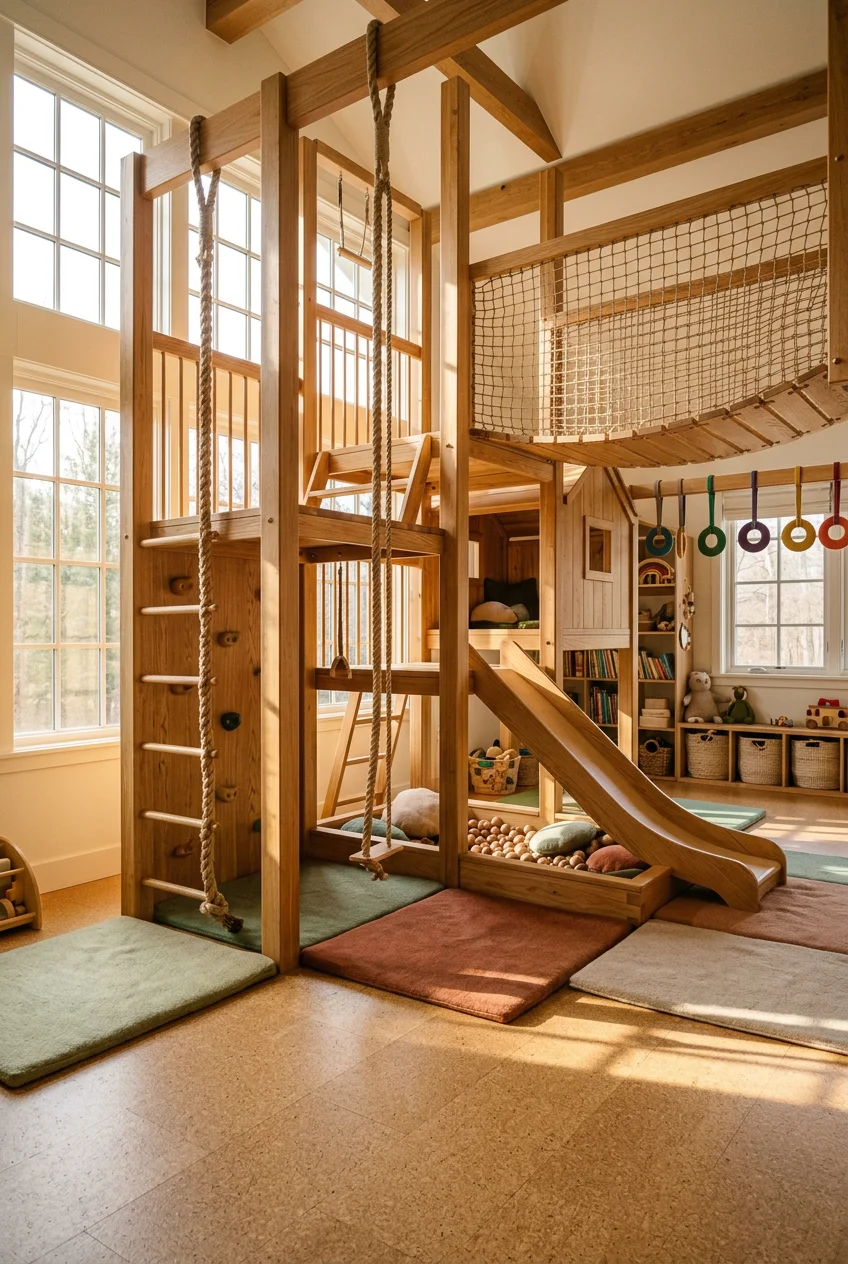
Last November, I walked into my living room to find my six-year-old using the $1,200 West Elm sofa as a launchpad to grab the ceiling fan pull chain. Building an indoor jungle gym playroom wasn’t about style. It was a survival tactic for my sanity and my furniture. Kids need to move. When it rains for four days straight here in Seattle, they turn into caged raccoons. I decided to convert our spare 12 by 12 foot guest room into a functional movement space. I thought slapping down a rug and a plastic slide would work. I was wrong. Within three days, someone had a bruised knee and the drywall had a massive hole in it. You need proper materials, exact measurements, and structural integrity to make this work. Here’s exactly how I built a space that handles wild kids and my own workout routines without falling apart.
1. Prioritize Safety Flooring with Specific Thicknesses

Let’s talk about the ground first. Most people skip this and just use the carpet they already have. That’s a mistake. Carpet gives you rug burns and offers zero impact absorption when someone falls off a monkey bar. I started with cheap $15 interlocking mats from Walmart. They slid apart constantly and felt like walking on stale bread. I ended up throwing them away. You need specific impact-absorbing flooring to mitigate injuries. For the general walking and tumbling areas, I bought the ProSourceFit Foam Puzzle Play Mats at ⅝-inch thickness. A pack of 24 square feet costs $24.99. They have a subtle diamond texture on top that grips bare feet well. For the higher fall zones directly under the climbing structures, you need something thicker. I bought Rubber-Cal Indoor Playground Tiles that are 1 ⅝ inches thick. They cost $45 per 24 by 24 inch tile. These specific tiles carry a 4-foot fall height ASTM rating. When you drop a 15-pound kettlebell on them, it just bounces with a dull thud instead of cracking the concrete subfloor. I bought these at Costco last January. The rubber smell is intense for the first three days. Leave your windows open and run a box fan. The thick rubber handles my heavy jump rope sessions and softens the landing when my youngest misses a swing dismount.
2. Anchor Everything to the Studs

Don’t trust drywall anchors for anything that holds human weight. I learned that the hard way last Tuesday. I tried to mount a lightweight climbing rope using heavy-duty toggle bolts rated for 100 pounds. My eight-year-old grabbed it, swung once, and ripped a six-inch chunk of drywall straight out of the wall. White dust went everywhere. I spent three hours patching and painting instead of working out. You’ve got to find the wooden studs. I use a Zircon StudSensor HD55 that I bought at Target for $22.99. Once you find the dead center of the stud, you need real hardware. I buy 3/8-inch by 3-inch galvanized lag bolts from Home Depot for $0.48 each. You must pre-drill the holes with a 1/4-inch drill bit first. If you skip pre-drilling, you’ll split the 2×4 inside the wall and ruin the structural integrity. I use a DeWalt 20V Max impact driver to sink the lag bolts. The sound is loud and ratchety, but when that bolt sits flush against the metal bracket, it won’t budge. I can hang from a bracket secured this way, and I weigh 195 pounds. This step takes twice as long as you think it will. Measure three times.
3. Install a Swedish Wall Ladder for Versatility

A Swedish wall ladder is the backbone of the room. It takes up zero floor space because it sits flush against the wall. I bought the Avenlur Swedish Wall for $299. It stands 8 feet tall and 32 inches wide. The rungs are made of solid pine and have a smooth, clear-coat finish that doesn’t give splinters. The wood feels slightly cool to the touch and provides excellent grip. I use the top rung for strict dead-hang pull-ups, while the kids use the lower rungs to stretch or climb up to the monkey bars. Installation requires two adults. I tried to lift the 45-pound assembled ladder by myself while holding a drill. I dropped it on my foot and bruised my big toe badly. Get someone to hold it. The ladder comes with steel L-brackets. You secure these brackets into the wall studs using the lag bolts I mentioned earlier. I bought a set of 1.5-inch thick resistance bands from Target for $14.99 and loop them around the middle rungs for tricep pushdowns. The kids tie their cotton jump ropes to the bottom rungs to make tripwires. It serves multiple purposes for different fitness levels. You might also like: 20 Charming Black Garage Home Gym Setup Ideas Worth Trying This Year

Elite Jumps Adjustable Jump Rope
A dependable everyday pick — Elite Jumps Adjustable Jump Rope – 6mm PVC Training Rope for Fitness & pulls in 1 ratings at 4.5 stars. Not flashy, just solid.
4. Add Heavy-Duty Ceiling Hooks for Swings in Your Indoor Jungle Gym Playroom

A ceiling swing changes the entire dynamic of an indoor jungle gym playroom. You need absolute confidence in your ceiling joists to do this right. I bought two Rogue Fitness Wood Gymnastics Rings for $75. They come with 1.5-inch wide heavy-duty nylon straps and metal cam buckles. The wood rings have a 1.25-inch grip diameter. They soak up chalk well and don’t slip when your hands get sweaty. To hang them, I bought two Eapele Heavy Duty Swing Hangers for $18.99 on Amazon. They’re rated for 1,000 pounds. I installed them directly into the ceiling joists above the thick rubber mats. At first, the metal-on-metal friction of the carabiner rubbing against the hanger made a high-pitched squeak that echoed through the whole house. I sprayed a quick burst of WD-40 on the joint. The smell of the aerosol oil lingered for an hour, but the squeak stopped completely. Now the rings swing in total silence. I do muscle-ups on them in the mornings. In the afternoons, the kids hang upside down like bats. The straps are fully adjustable, so you can lower them to 2 feet off the ground for toddlers or raise them to 7 feet for adults.
5. Incorporate a Bouldering Wall with Textured Holds

Climbing builds incredible grip strength and spatial awareness. I built a small bouldering section using a 4 by 8 foot sheet of 3/4-inch ACX plywood. Don’t use MDF or particleboard. It’ll crumble when you tighten the bolts. The plywood cost me $48 at Lowe’s. I painted it with a matte gray interior latex paint. For the holds, I bought a Metolius 40-pack of bolt-on climbing holds for $59.95. They’re made of a gritty polyurethane resin. They feel exactly like rough sandpaper. This texture is necessary because smooth plastic holds get slippery fast. I drilled 7/16-inch holes in a grid pattern every 8 inches across the plywood. Then I hammered steel T-nuts into the back of the board. This allows you to move the holds around easily with a 5/16-inch Allen wrench. I made the mistake of putting all the small crimp holds at the bottom. My kids couldn’t even get off the floor. I had to unscrew them and swap them for the large jug holds. I stopped at Sprouts later that day to buy a $6 bag of raw almonds because my forearms were so smoked from tightening forty bolts by hand. You might also like: 15 Brilliant Man Shed Home Gym Setup Ideas to Transform Your Space
6. Use Crash Pads for the High Fall Zones

Even with the 1 ⅝-inch rubber tiles, you need localized thick padding under the bouldering wall and the rings. I bought the Mad Rock Mad Pad crash pad for $189. It measures 5 feet by 4 feet when unfolded and is a full 5 inches thick. It uses a combination of open-cell and closed-cell foam. The outer shell is a durable nylon that feels like a heavy backpack material. When you step on it, you sink in about an inch before the dense foam stops you. It completely absorbs the shock of a 6-foot drop. The downside is that it’s bulky. You can’t just leave it in the middle of the floor when you want to do yoga. I fold it in half and secure it with the attached aluminum buckles. I lean it against the wall when we aren’t doing aerial stuff. When I first opened the plastic shipping bag, the foam off-gassed a strong chemical smell that gave me a slight headache. I had to leave it in the garage for two days to air out. Now it just smells faintly of dusty chalk. It’s worth the money because it prevents broken ankles. You might also like: 10 Gym Poses For Men You Need to See

Ally Peaks Pull Up Bar for Doorway | Thickened Steel Max
Ally Peaks Pull Up Bar for Doorway | Thickened Steel Max Limit 440 lbs has been one of the most consistently praised picks in this category. 128 reviewers averaged 4.5/5.
7. Hang a Cargo Climbing Net for Core Strength

A cargo net forces you to use stabilizing muscles you didn’t know you had. I ordered a Safari Rope Net that measures 4 feet wide by 8 feet long. It cost $120. The net is constructed from 3/4-inch synthetic manila rope. I chose synthetic over natural manila because natural rope sheds tiny, itchy fibers everywhere and smells like a wet dog when the humidity rises. The synthetic version looks like real hemp but is soft on bare hands. The squares are 9 inches by 9 inches. This is wide enough for an adult work boot but tight enough that a child won’t slip entirely through. I secured the top of the net to a ceiling joist using three heavy-duty eye lags. I anchored the bottom to the floor using concrete wedge anchors. The net must be pulled extremely taut. If it hangs loose, it becomes a tangled hazard rather than a climbing structure. I scraped my knuckles raw pulling the bottom rope tight against the concrete. I actually had to run to Kroger to buy a $4 box of Band-Aids and a bag of frozen peas for my hands afterward. The tension makes the net rigid enough to climb straight up without swinging wildly.
8. Set Up a Modular Obstacle Course

Fixed structures are great, but kids get bored if the room never changes. Modular soft blocks fix this problem. I bought a Nugget Comfort couch for $249. It consists of four foam pieces: two supportive base cushions that are 33 by 33 inches, and two triangle pillows. The covers are a soft microsuede that feels like a short-pile velvet. I chose the dark navy blue color because light colors show every single footprint. The foam is incredibly dense. I can stand on the base cushion and it barely compresses under my 195 pounds. We use these pieces to build forts, ramps, and hurdle jumps. Last month, I tried to wash the covers. Getting the foam back into the tight zipper casings took me twenty minutes of sweating and swearing. It’s a frustrating process. I usually grab an overpriced $8 turkey sandwich from Whole Foods just to stress-eat after laundry day. No exaggeration. Despite the tight covers, the modularity is essential. During my own workouts, I stack the two base cushions to create a 12-inch platform for box jumps and elevated push-ups. They grip the rubber floor tiles perfectly and don’t slide out from under me.
9. Install a Pull-Up Bar That Holds Adults

You need a dedicated, rigid pull-up bar. The wooden rungs on the Swedish ladder are fine, but they sit too close to the wall for kipping pull-ups or hanging knee raises. I bought the Titan Fitness Wall-Mounted Pull-Up Bar for $89.99. It extends 22 inches away from the wall. The bar itself is a 1.25-inch diameter steel tube with a black powder-coat finish. The powder coat has a slight grit to it that holds lifting chalk beautifully. I mounted the two L-brackets directly into the wall studs using four 3/8-inch lag bolts per bracket. The steel is heavy gauge. The box weighed 35 pounds when it arrived. I tried to balance the crossbar on my head while screwing in the side bolts. The bar slipped, hit me in the shoulder, and left a dark purple bruise for a week. Use a step ladder and a helper. The 22-inch clearance gives me enough room to swing my legs without kicking the drywall. My kids hang gymnastics rings from this bar when they don’t want to use the high ceiling hooks. It handles dynamic swinging movements without a single creak or groan.

Ally Peaks Pull Up Bar for Doorway | Thickened Steel Max
If you want something that just works, Ally Peaks Pull Up Bar for Doorway | Thickened Steel Max Limit 440 lbs is a safe bet (128 reviews, 4.5 stars).
10. Keep the Indoor Jungle Gym Playroom Ventilated

An indoor jungle gym playroom gets hot and smells like a locker room very quickly. Four people breathing heavily in a 144-square-foot room creates massive humidity. The windows fog up. The rubber mats get slick with sweat. I ignored ventilation for the first month. The room started smelling like stale corn chips and old socks. You need serious airflow. I bought a Vornado 660 Large Whole Room Air Circulator for $99.99. It moves air up to 100 feet. It’s not a standard oscillating fan. You point it at the ceiling in the corner of the room, and it creates a continuous current that bounces off the walls. The plastic housing is glossy black and it sits low to the ground. On the highest of its four speed settings, it sounds like a jet engine idling. It’s loud, but the white noise drowns out the sound of the kids arguing over who gets to use the swing next. I run it for an hour after every workout to dry the sweat off the mats and the climbing holds. I was so exhausted after wiring the new outlet for this fan that I drove to Trader Joe’s and bought three of their $5.99 frozen pepperoni pizzas because I refused to cook dinner.
Building this space took three weekends of measuring, drilling, and adjusting. I made plenty of mistakes, bought the wrong anchors, and bruised a few limbs in the process. But the result is a room that actually gets used every single day. The kids burn off their chaotic energy on the climbing walls, and I’ve got a solid setup for my own bodyweight training. If you plan your anchor points and invest in the right thickness for your rubber mats, the room will easily last until your kids outgrow it. I’d suggest keeping a small toolbox in the room. You’ll need to tighten the bolts on the climbing holds every three months as they settle. Pin this guide to your home gym or playroom boards so you have all the exact hardware dimensions and mat thicknesses handy when you head to the hardware store.
Frequently Asked Questions
What is the best flooring for an indoor jungle gym playroom?
You need impact-absorbing rubber mats. Skip regular carpet. I recommend using 5/8-inch foam puzzle mats for general play areas and upgrading to 1 5/8-inch thick rubber playground tiles under high fall zones like swings and climbing walls.
How do you safely anchor an indoor jungle gym playroom to the wall?
Never use drywall anchors. You must locate the wooden wall studs using a stud finder. Pre-drill your holes and use 3/8-inch thick galvanized lag bolts to secure all brackets and ladders directly into the structural wood.
Can adults use an indoor jungle gym playroom for workouts?
Yes, if you use heavy-duty hardware. I use our playroom for my daily workouts. By installing a steel pull-up bar, a Swedish ladder, and rated gymnastics rings anchored to the ceiling joists, the space handles adult bodyweight training perfectly.
How do you keep an indoor jungle gym playroom from smelling bad?
Rubber mats and sweaty workouts create intense humidity and odors. You need active air circulation. I run a high-powered room circulator fan pointed at the ceiling for an hour after every session to dry the sweat and prevent stale odors.
