What’s Inside
- Choose The Right Type For Your Medicine Ball Workout
- Select The Correct Weight To Maximize Effectiveness
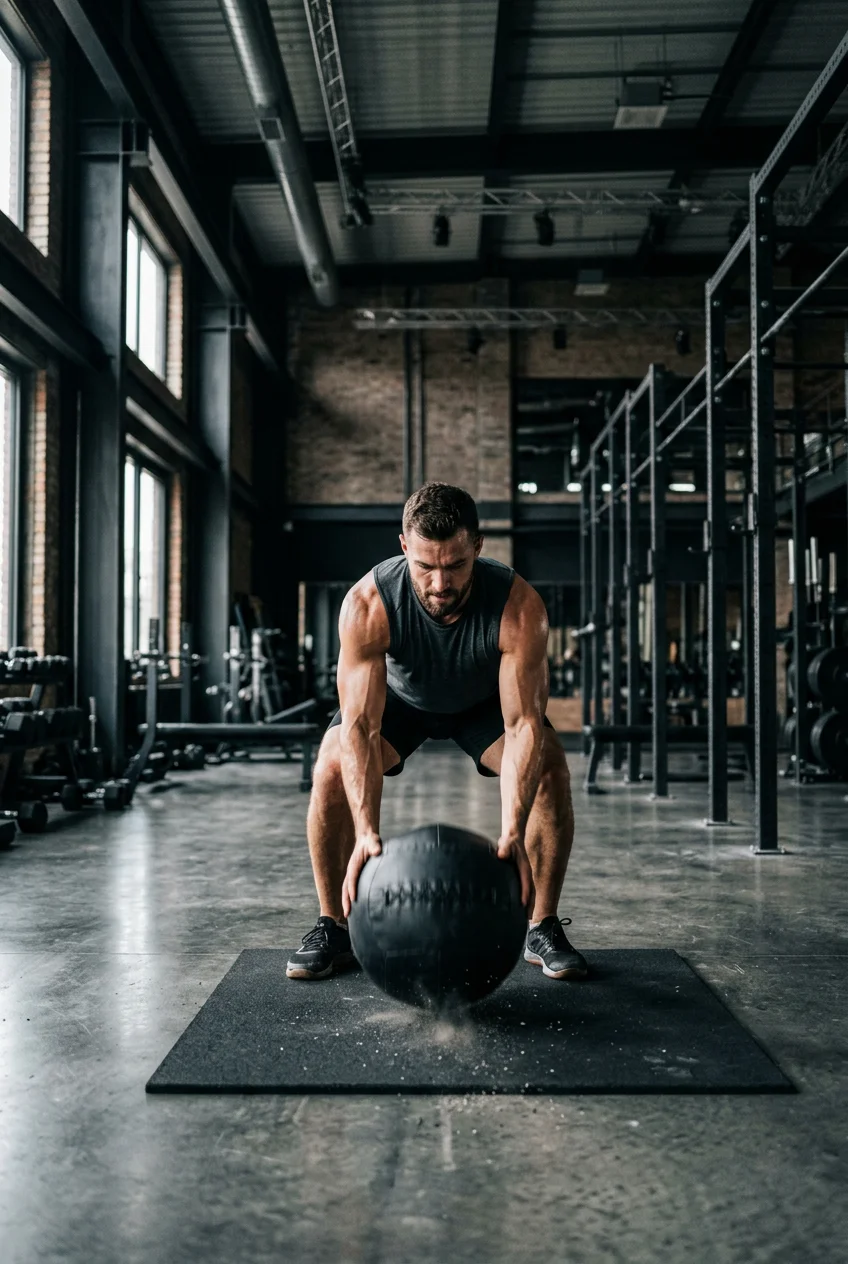
- Master The Slam For A High-Calorie Medicine Ball Workout
- Incorporate Rotational Throws For Sport-Specific Power
- Utilize Wall Ball Shots For Combined Cardio And Strength
- Avoid Using An Overly Heavy Ball For Power Training
- Build A Resilient Core With Traditional Bouncy Balls
- Try Medicine Balls With Handles For Dynamic Wood Chops
Last Tuesday at Dick’s Sporting Goods, I watched a guy almost knock his own teeth out. He was trying a medicine ball workout with a bouncy 20-pound rubber sphere, slammed it onto the concrete, and barely dodged the violent rebound. I stepped in before he could try rep number two and pointed him toward the dead-weight slam balls instead. That near-miss reminded me how often people grab the wrong gear for the wrong movement, turning a good training session into a liability. A solid weighted ball routine burns calories fast and builds explosive power, but only if you understand the gear.
When I first started training clients, I made the same mistake. I bought a cheap $15 synthetic leather ball from Walmart, tried to use it for heavy wall shots, and the seams busted on the third throw. It dumped four pounds of sand all over the black rubber gym mats. It took me an hour to vacuum up that gritty mess, and the vacuum still rattles—learned that the hard way. Since then, I’ve spent years testing these spheres to see what holds up to abuse. The right tool makes the movement click; the wrong one just frustrates you. Let’s break down how to use them without destroying your face or your floor.
1. Choose The Right Type For Your Medicine Ball Workout

Not all weighted balls belong in the same category. Pick the wrong shell, and you’re going to have a terrible time. You need to select the type based on the specific exercise. Slam balls are built for forceful throws against the ground. They have a thick rubber shell and are filled with shifting sand, so they hit the floor with a heavy thud and don’t bounce. This makes them ideal for high-intensity work. I use the TRX Training Slam Ball in my garage gym. I bought the 20-pound version for $49.95, and the textured tire-tread grip is vital when my hands get sweaty. The Rogue Echo Slam Ball is another solid choice for around $45, but the TRX grip feels slightly more secure to me.
Wall balls are a different animal. They’re softer, much larger—usually 14 inches across—and covered in stitched vinyl or synthetic leather. They’re meant to be thrown against a target and caught. Traditional medicine balls are the smaller, bouncy rubber ones you see scattered around gyms. They bounce back and are great for partner tosses or core work. I picked up an Amazon Basics Medicine Ball (10 lbs for $28.49) last year, and it works fine for seated Russian twists. Just don’t slam it. I tried slamming a bouncy rubber ball once and jammed my wrist catching the unpredictable rebound. Stick to the dead-weight sand versions if you’re hitting the floor.
2. Select The Correct Weight To Maximize Effectiveness

The right weight is vital, and most guys in the gym get this wrong. Ego lifting with a weighted sphere ruins the point. For beginners, start light, maybe in the 4 to 6-pound range. This lets you prioritize form, hip hinging, and speed before adding resistance. I bought a 6-pound Cap Barbell ball at Target for $22.99 to teach new clients the mechanics of a proper throw. The lighter weight forces them to use their hips instead of just muscling it with their shoulders.
When you’re chasing explosive power, a lighter ball is often better than a heavy one. Men’s Health fitness director Ebenezer Samuel advises that you’re better off with a lighter med ball than you think. He’s right. Power is speed multiplied by force. If you grab a 30-pounder and move like a slug, you aren’t building power. You’re just doing a slow front raise. For strength and rehab, you can go heavier. BodySport offers a range of rubber balls from 2 lbs up to 18 lbs. I bought their 18-pound version for $42.50 for heavy goblet squats. If you want a full progression, the SMAI Medicine Ball Set gives you weights from 8 to 20 lbs. I usually tell people to buy two: a light 8-pounder for rotational speed and a heavier 20-pound slam ball for conditioning.
3. Master The Slam For A High-Calorie Medicine Ball Workout

The overhead slam is a great exercise for full-body power and spiking your heart rate. It looks simple, but the mechanics require coordination. To do it right, stand with feet hip-width apart. Raise the ball high overhead with extended arms, coming up onto your toes. Then, forcefully slam it down between your feet by hinging at your hips and pulling your arms down. You should finish in a partial squat. This engages your lats, shoulders, core, glutes, and hamstrings. You might also like: 15 Creative Workout Motivation Tips You Haven’t Thought Of
The biggest mistake I see is people just bending at the waist and dropping the weight. That doesn’t do anything. You have to actively throw it through the floor. I use the REP Fitness Slam Ball (15 lbs for $34.99) for my high-volume circuits. The rubber has a sharp, chemical smell at first, but it fades after a week. Last month, I was doing a set of fifty slams in my driveway, and my neighbor came over to ask about the noise. I let him try three reps with my 15-pound REP ball, and he immediately understood. His heart rate was through the roof in twenty seconds. Always use a dead-weight ball for this. If you use a bouncy one, you’ll take a 15-pound rubber sphere to the chin. I’ve seen it happen, and it’s not pretty. You might also like: 15 Brilliant Man Shed Home Gym Setup Ideas to Transform Your Space

kisnbld Small Exercise Ball, 9 Inch Mini Pilates Ball
If you want something that just works, kisnbld Small Exercise Ball is a safe bet (22 reviews, 4.5 stars).
4. Incorporate Rotational Throws For Sport-Specific Power

Rotational throws are vital for sports like golf, baseball, and tennis. Even if you just want a stronger core, this delivers results that crunches can’t. To set up, stand sideways about three feet from a sturdy wall. Hold the ball at your back hip. Transfer your weight from your back foot to your front, rotate your torso, and explosively throw the weight against the wall. Catch it and repeat. The power must come from your hips, not your arms. You might also like: 20 Gorgeous Garage Home Gym Setup Ideas to Steal Right Now
A common mistake is relying on upper body strength. You aren’t doing a sideways chest press. You’re transferring force from the ground up. I learned this the hard way. I tried rotational throws against the drywall in my garage using an Amazon Basics Traditional Medicine Ball (12 lbs, $32.15). I thought I was far enough from the studs, but the impact punched a hole in the sheetrock. I spent my Sunday patching and painting. Now, I only do these against the exterior brick wall. The 12-pound weight is the sweet spot. It’s heavy enough to provide resistance but light enough to maintain speed. If your back tweaks, you’re twisting your spine instead of pivoting your back foot. Pivot like you’re squashing a bug.
5. Utilize Wall Ball Shots For Combined Cardio And Strength

Wall ball shots are a staple in CrossFit, and for good reason. They are brutal. To do a proper shot, stand facing a wall with feet shoulder-width apart. Hold a large, soft wall ball at chest level, elbows tucked. Squat down, keeping your chest up. As you drive out of the hole, explode up and throw the ball at a target ten feet high. Catch the sphere as it rebounds, absorbing the weight by dropping into your next squat. Stringing twenty of these together will leave you gasping.
This combines leg strength, pushing power, and cardio. It targets the quads, glutes, deltoids, and triceps. I use the Yes4All Wall Ball (14 lbs, $39.99) for my home workouts. The synthetic leather feels soft against my chin, and the stitching has held up for two years. I used to hate this exercise because I’d lose my balance on the catch. I realized I was standing too far from the wall. Once I moved to 18 inches away, the trajectory fixed itself. After a grueling set last summer, my quads were burning so badly I had to sit on a cooler for ten minutes. I drove to Whole Foods and bought a $5 bottle of electrolyte water because I’d sweated through my shirt.
6. Avoid Using An Overly Heavy Ball For Power Training

I see guys making this error constantly. They walk over to the rack, ignore the 8-pound and 10-pound options, and grab the 30-pound sphere for chest passes. The result is a slow, grinding movement that misses the point of power training. Power requires velocity. If the implement is too heavy, your central nervous system can’t recruit muscle fibers fast enough for an explosive contraction. You end up turning a dynamic movement into a slow strength exercise.
I fell into this trap a few years ago. I bought a 25-pound rubber ball, thinking heavier would make me faster. I tried overhead throws for distance in a park. The weight was so cumbersome that it threw off my release, and the rubber tore a callous right off my palm. I switched to a BodySport 8-pound rubber ball online for $24.95. The difference was immediate. With the 8-pound weight, I could violently snap my hips and release at max speed. My throws went further, and my core felt more engaged. If your goal is to move fast, use a weight that lets you move fast. Leave the heavy grinding for your barbell deadlifts. Use the spheres for speed.

YOTTOY Anti-Burst Exercise Ball for Working Out
YOTTOY Anti-Burst Exercise Ball for Working Out punches above its price — 24 buyers rated it 4.5 stars. I would buy it again.
7. Build A Resilient Core With Traditional Bouncy Balls

While I advocate for dead-weight options for ground strikes, traditional bouncy rubber spheres are great for isolated core work on a mat. The rubber provides a tacky grip. I like to program a circuit of Russian twists, V-ups, and overhead sit-ups. For Russian twists, sit, lean back slightly, elevate your feet, and tap the weight on the floor beside your left hip, then your right. The rubber exterior is perfect for this because it won’t scratch your floors.
I use a Champion Sports 4-pound rubber ball ($18.50) for my high-rep circuits. Last Thursday, I was doing a circuit in my living room on a cheap mat from Kroger. The 4-pound weight sounds light, but after three minutes of V-ups and twists, my abdominals were cramping. The textured rubber of the Champion Sports ball smells like a new bicycle tire, which is oddly nostalgic. One mistake people make is moving their arms side to side while keeping their chest forward. That’s useless. You have to rotate your entire shoulder girdle so your chest points toward the wall on each side. The weight is just there to add resistance.
8. Try Medicine Balls With Handles For Dynamic Wood Chops

Most standard weighted spheres are hard to grip with one hand, which limits your range of motion. If you want to perform sweeping movements like wood chops or single-arm overhead presses, you need an option with handles. These look like a steering wheel with a heavy core. They allow for a secure grip, so you can swing the weight without it flying out of your hands and smashing a window—took me years to figure that out.
I picked up the CanDo One Handle Medicine Ball (10 lbs, $45.00) for rotational wood chops. To do the chop, stand with feet wider than shoulder-width. Grip the handle, start with the weight by your right ear, and chop down toward your left knee, pivoting your right foot. The handle lets me pull with my lats instead of just cupping the ball. Before I bought the CanDo version, I tried wood chops with a smooth ball. My hands were sweaty, and the ball slipped, bouncing off my shin and leaving a bruise that lasted two weeks. I went to Costco later that day to buy frozen peas to ice my leg. The handle eliminates that risk. It gives you the grip of a dumbbell with the balance of a sphere, making it perfect for multi-planar movements.
Getting your gear right is the first step, but consistent effort is what changes your physique. I recommend picking up a 10-pound dead-weight slam ball and a 14-pound soft wall ball to start your own home routine. Save this article for your next garage gym session, and remember to focus on speed and hip power rather than just lifting the heaviest sphere you can find.
Frequently Asked Questions
What is the best weight for a medicine ball workout?
Beginners should start with a 4 to 6-pound ball to master form. For explosive power training, 8 to 12 pounds is ideal to maintain high movement speed. Heavy balls over 20 pounds are better suited for slow strength movements like goblet squats.
Can I use a bouncy medicine ball for slams?
No, you shouldn’t use a bouncy rubber ball for floor strikes. It will aggressively rebound and can hit you in the face. Always use a dead-weight, sand-filled slam ball for any exercise where you forcefully throw the weight at the ground.
What muscles do wall ball shots work?
Wall ball shots are a full-body movement. The deep squat targets your quads, glutes, and hamstrings, while the explosive upward throw heavily engages your anterior deltoids, triceps, upper chest, and core stabilizers.
How do I stop my lower back from hurting during rotational throws?
Lower back pain during rotational throws usually happens because you aren’t pivoting your back foot. You must transfer power from your hips and pivot your trailing foot like you’re squashing a bug, rather than twisting your lumbar spine.
