What’s Inside
- The Ultimate Exercise For Thighs: Barbell Back Squats
- Bulgarian Split Squats for Unilateral Balance
- Romanian Deadlifts for Hamstring Dominance
- The Best Bodyweight Exercise For Thighs: Copenhagen Planks
- Resistance Bands for Outer Thigh Activation
- Blood Flow Restriction (BFR) Training
- Nordic Hamstring Curls for Eccentric Strength
- Progressive Overload Tactics for Growth
- Foam Rolling for Enhanced Recovery
- Advanced Bodyweight Exercises: Pistol Squats
- Cable Work for Inner and Outer Thigh Specificity
- Proper Nutrition and Rest for Muscle Growth
Last Tuesday at my local gym, I watched a guy load four plates onto the leg press, lower the sled two inches, and rack it with a massive grunt. I used to be that guy until I realized half-repping heavy weights isn’t real training for your thighs. If you want legs that actually grow, check your ego at the door and focus on depth, tension, and mobility. I spent years dealing with chronic knee pain and chicken legs before I figured out how to train properly. My quads were weak. My hamstrings were basically decorative strings. Let’s fix that right now. Here is exactly what works based on a decade of training clients and destroying my own legs. I learned it the hard way.
1. The Ultimate Exercise For Thighs: Barbell Back Squats

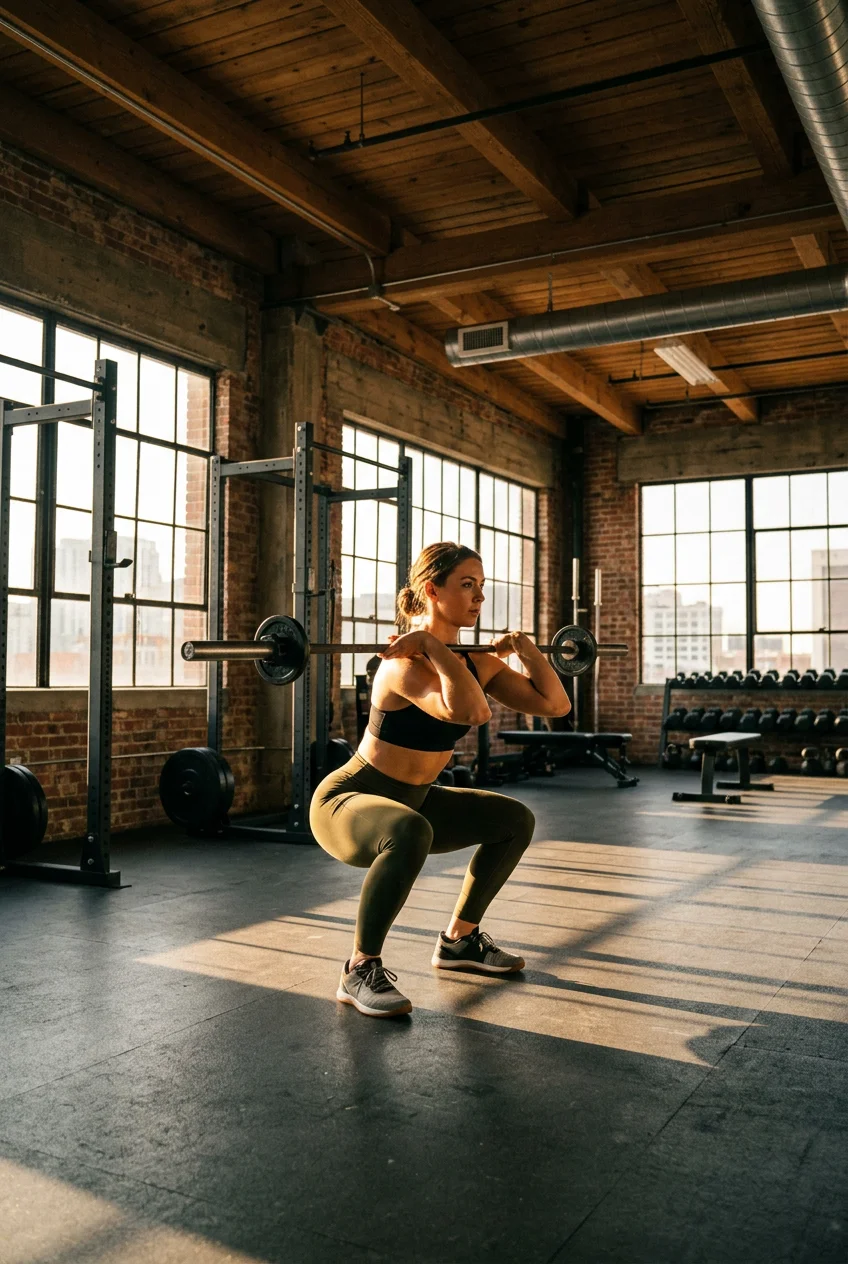
The barbell back squat is the foundation of any serious leg routine. It builds mass and strength across your quads, hamstrings, and glutes all at once. Aim for 3 to 4 sets of 6 to 10 repetitions. You need to get your hips below your knees to see real growth. Arnold Schwarzenegger used to tell lifters to “Go Deep” to maximize quad mass, even if it meant dropping the weight. I ignored this for years. I loaded up the bar, did shallow quarter squats, and wondered why my legs weren’t growing. The turning point was buying a Rogue Fitness Ohio Bar for $345 and a starter set of REP Fitness bumper plates for $250 for my garage gym. The sharp knurling on the Rogue bar dug into my traps just enough to keep the steel glued to my back during heavy sets. I remember making a late-night run to Target to grab a $4 block of gymnast chalk because my hands were slipping on the sweaty bar in the humid August heat. Chalk up, grip the bar tight, and lower yourself until your thighs break parallel to the floor. A common mistake is letting your knees cave inward at the bottom. Push them out forcefully. Trust me on this.
2. Bulgarian Split Squats for Unilateral Balance

Unilateral movements isolate each leg to fix glaring strength imbalances. The Bulgarian split squat is brutal but necessary. Perform 3 sets of 8 to 12 repetitions per leg. I hold a pair of 40-pound Amazon Basics rubber hex dumbbells. They cost me $50 each and smell faintly of tire rubber, but the hex shape keeps them from rolling across the slanted garage floor between sets. You need a knee-height surface for your back foot. I use a REP Fitness Adjustable Bench that cost $259. When I first tried these, I put my back foot way too high on a plyo box and face-planted onto the rubber gym floor. My left hip flexor screamed in pain for three days. Lower the bench height. Position your rear foot securely and lower your body until your front thigh is parallel to the ground. The burning sensation in your front quad is intense. Don’t rush the downward portion. A huge pro tip is to lean your torso slightly forward to target the glutes or stay upright to torch the quads. Most people use way too much weight initially. Drop the dumbbells and master your body weight first.
3. Romanian Deadlifts for Hamstring Dominance

Romanian Deadlifts, or RDLs, target the back of your legs through a strict hip hinge. You need this to balance out all the heavy quad work. Execute 3 to 4 sets of 8 to 12 repetitions. Use a barbell or heavy dumbbells. Maintain a slight bend in your knees and keep your back flat. Lower the weight until you feel a deep, uncomfortable stretch in your hamstrings. This usually happens when the bar reaches your mid-shin. I used to round my lower back on these until I tweaked a spinal erector on a heavy rep. That dumb mistake cost me three weeks of training. Now, I focus entirely on pushing my hips back toward the wall. For grip, I use a pair of Harbinger lifting straps I picked up at Walmart for $14.99. The rough cotton canvas bites into my wrists, but it stops the heavy bar from rolling out of my sweaty palms. Squeeze your glutes hard to drive through your hips and return to a standing position. Don’t overextend your lower back at the top. Just stand tall.

Trideer Exercise Ball for Yoga, Pilates & Fitness
Trideer Exercise Ball for Yoga punches above its price — 529 buyers rated it 4.5 stars. I would buy it again.
4. The Best Bodyweight Exercise For Thighs: Copenhagen Planks

You probably ignore your inner thighs. Most guys do. The Copenhagen plank is a highly effective move that targets the adductor muscles. It improves hip stability and drastically reduces your risk of a groin tear. Perform 2 to 3 sets, holding the static position for 30 to 60 seconds per side. You set up in a standard side plank, but your top leg rests on a bench while your bottom leg hovers. The first time I tried this last winter, my right inner thigh cramped so violently I fell right off the bench. I had to limp into Whole Foods later that afternoon to buy a $3.50 bottle of Harmless Harvest coconut water just to get some potassium in my system. The tension on the adductor is unlike anything else. If a full plank is too hard, bend your top knee and rest your shin on the bench instead of your foot. This shortens the lever and makes it manageable. Don’t let your hips sag toward the floor. Keep your body in a straight line from your shoulders to your ankles. You might also like: 15 Cozy Aesthetic Morning Workout Routine That Are Totally Worth It
5. Resistance Bands for Outer Thigh Activation

You need lateral stability for heavy squats and daily life. Resistance bands target the gluteus medius and minimus. These muscles handle hip abduction and prevent your knees from caving. I incorporate banded lateral walks and clamshells for 3 sets of 15 to 20 repetitions. I use the Mark Bell Sling Shot Hip Circle. It costs $22.50. Before this, I used those cheap rubber physical therapy bands. They constantly rolled up my legs and pinched my skin. The Sling Shot is thick woven fabric. It stays put. I use the blue medium-resistance band. Warm up with these before you touch a barbell. Last month, I skipped my banded warm-up, went straight into heavy squats, and my knees caved inward instantly on the first working set. Lesson learned. I usually do my banded walks in the garage while chewing on a $2.99 pack of dried mango from Sprouts. It gives me a quick hit of carbs before the heavy lifting starts. Keep your toes pointed straight forward during lateral walks. If your toes turn out, your hip flexors take over.
6. Blood Flow Restriction (BFR) Training

Blood Flow Restriction training sounds like a gimmick, but the science is solid. BFR allows you to build muscle using 20 to 30 percent of your one-rep max. You apply a cuff to the top of your thigh to restrict venous blood return while allowing arterial blood flow. I use the SmartCuffs 4.0. They retail for $399. The automated pump whirs loudly as it calibrates your specific occlusion pressure. You perform exercises like leg presses for 3 to 4 sets of 15 to 30 repetitions with only 30-second rest periods. The metabolic stress is agonizing. Your legs swell with trapped blood and lactic acid. It feels like your quads are encased in tight, burning concrete. I tried cheap elastic knee wraps for BFR once. I tied them way too tight, my toes went numb, and I almost passed out. Buy actual pneumatic cuffs. BFR is perfect for deload weeks or working around joint pain. You get a massive growth stimulus without loading heavy weight on your spine or fragile knees. You might also like: 12 Flat Tummy Workout for Every Budget
Trideer Exercise Ball for Yoga, Pilates & Fitness
A dependable everyday pick — Trideer Exercise Ball for Yoga pulls in 529 ratings at 4.5 stars. Not flashy, just solid.
7. Nordic Hamstring Curls for Eccentric Strength

Nordic hamstring curls are humbling. They boost eccentric hamstring strength and can reduce injury rates by 51 percent in athletes. This is a bodyweight move where you kneel, secure your ankles, and slowly lower your torso toward the floor. You resist gravity with your hamstrings. Start with 3 sets of 6 to 8 controlled repetitions. I do these by wedging my heels firmly under a loaded barbell. The first time I attempted a full Nordic, my hamstrings gave out halfway down, and I slammed my chest hard into the floor. The soreness the next day was so bad I had to drive to Kroger and buy a $2.49 bag of crushed ice for a miserable ice bath. Use a PVC pipe or heavy resistance band to assist yourself on the way down until you build the baseline strength. The goal is a slow, agonizing five-second descent. Don’t break at the hips. Keep a straight line from your knees to your shoulders. You might also like: 15 Brilliant Dark Basements Home Gym Setup Ideas Worth Trying This Year
8. Progressive Overload Tactics for Growth

Doing the exact same workout every single week yields zero results. You must embrace progressive overload. This means gradually increasing the demands on your muscles. You can add weight, increase repetitions, add sets, or decrease rest times. For heavy goblet squats, I use a 40-pound Rogue Fitness Kettlebell. It costs $55. The cast iron handle is textured and holds chalk well. Once I can easily hit 3 sets of 12 reps with the 40-pounder, I won’t just keep doing it. I buy the 45-pound bell. A massive mistake I made in my early twenties was lifting the same 135 pounds on squats for six months straight. My legs stayed exactly the same size. Track your workouts in a cheap notebook. If you did 10 reps last week, fight for 11 reps this week. Mechanical tension drives growth. Don’t compromise your form just to add five pounds to the bar. Shitty reps won’t help you. Control the weight, hit depth, and force your body to adapt.
9. Foam Rolling for Enhanced Recovery

Recovery dictates how fast your legs grow. Foam rolling your quads, hamstrings, and IT bands breaks up adhesions and improves blood flow. I use the TriggerPoint Grid 1.0 foam roller. It costs $34.99 and has a rigid hollow core wrapped in dense EVA foam. The grid pattern mimics a massage therapist’s hands. Spend 5 to 10 minutes rolling before and after your workouts. When you find a tender spot, stop and hold the pressure for 30 to 60 seconds. I rolled my IT band last Thursday and the pain was so sharp I actually sweated through my t-shirt. The foam crunched against the tight muscle fibers. Do not roll directly over your kneecap or hip bone. Stay on the muscle belly. I used to think foam rolling was a waste of time until I developed patellar tendonitis. Loosening my tight quads fixed the knee pain in two weeks. It hurts, but the increased mobility makes your squats feel smooth.

YOTTOY Anti-Burst Exercise Ball for Working Out
YOTTOY Anti-Burst Exercise Ball for Working Out punches above its price — 24 buyers rated it 4.5 stars. I would buy it again.
10. Advanced Bodyweight Exercises: Pistol Squats

You don’t always need iron plates to build serious strength. Advanced bodyweight movements like pistol squats demand balance, mobility, and unilateral power. A pistol squat is a one-legged squat where your non-working leg points straight out. Aim for 3 sets of 5 to 8 repetitions per leg. I spent three months falling backward onto my butt before I nailed my first clean rep. My ankle mobility was terrible. I started by holding onto a TRX strap to keep myself upright. The tension on your patellar tendon is high, so warm up thoroughly. I usually practice these on my active recovery days. Afterward, I always mix a shake using Optimum Nutrition Gold Standard Whey that I buy in bulk from Costco. A 5.64-pound bag runs about $64.99. The rich double chocolate flavor masks the chalky texture of the protein perfectly. Pistol squats expose every weakness in your lower body. If your glutes are weak, your knee will cave. If your ankles are stiff, your heel will lift.
11. Cable Work for Inner and Outer Thigh Specificity

Free weights are great, but cable machines provide constant tension. To specifically target your adductors and abductors, use a low cable pulley. Perform cable hip adductions and abductions for 3 sets of 12 to 15 repetitions per leg. You need a good ankle strap. I use a DMoose Fitness Ankle Strap that cost me $14.99 on Amazon. The thick neoprene padding stops the nylon strap from biting into my skin when pulling heavy weight. Stand sideways to the machine. For adductions, pull the cable across the front of your body. For abductions, sweep your leg out. I used to swing my whole torso to move the weight. It’s a common mistake. Lock your upper body down completely. Hold onto the machine frame. The only thing moving should be your leg. The burn from the constant cable tension is completely different from dumbbells. It isolates the small stabilizing muscles that keep your hips healthy.
12. Proper Nutrition and Rest for Muscle Growth

You break muscle down in the gym. You build it while you sleep and eat. Aim for 7 to 9 hours of quality sleep every single night. Your diet needs to be rich in protein to fuel muscle repair. I aim for 1.6 to 2.2 grams of protein per kilogram of body weight. My staple protein source is the organic free-range chicken breast from Trader Joe’s. A one-pound pack costs $6.99. I grill it with a heavy coat of salt and pepper. It gets a nice charred crust on the outside but stays juicy inside. Skip the fat-free stuff. It tastes like wet cardboard. You need healthy fats for optimal hormone production. Allow at least 48 hours of rest between heavy leg sessions. I tried squatting heavy three days a week back in 2024. My central nervous system fried, and my lifts actually went down. More is not always better. Eat your protein, get some sleep, and let your body recover.
I’ve tried almost every leg routine out there, and these twelve principles are the foundation of actual progress. Stop wasting time on leg extensions alone and start squatting deep. I’d highly recommend saving this page or pinning it for your next leg day so you don’t forget the form cues. Your thighs won’t grow until you force them to. No exaggeration.

Trideer Exercise Ball for Yoga, Pilates & Fitness
Trideer Exercise Ball for Yoga has been one of the most consistently praised picks in this category. 529 reviewers averaged 4.5/5.
Frequently Asked Questions
What is the best exercise for thighs?
The barbell back squat is the foundational exercise for thigh development. It heavily targets the quadriceps, hamstrings, and glutes simultaneously, allowing for maximum mechanical tension and progressive overload.
How often should I train my thighs?
Aim to train your thighs 2 to 3 times per week. Allow at least 48 hours of recovery between heavy leg sessions to prevent central nervous system fatigue and muscle overtraining.
Do I need to lift heavy to grow my thighs?
While heavy compound lifts are optimal, you can also build muscle using lighter weights with high repetitions or by utilizing Blood Flow Restriction (BFR) training, which creates massive metabolic stress.
Why do my knees cave in during squats?
Knee valgus, or caving inward, is usually caused by weak gluteus medius muscles or poor ankle mobility. Incorporate banded lateral walks and clamshells to strengthen your hip abductors.
